
Imposter Syndrome vs Low Self-Confidence: What's the Difference?
Imposter syndrome and low self-confidence can both create self-doubt, but they are not the same experience. Low self-confidence usually involves questioning whether you have the ability to succeed, while imposter syndrome can make you question whether your proven success and competence are genuinely deserved.
This distinction matters because someone may perform well and appear confident yet still feel like a fraud internally. This guide explains imposter syndrome vs low self-confidence, how they differ from related concepts, and how to recognize each pattern.
A Quick Answer
Imposter syndrome and low self-confidence differ in what you doubt. Low self-confidence means questioning whether you have the ability to handle a task or succeed, while imposter syndrome means doubting whether your demonstrated competence and achievements are genuinely deserved.
Someone with imposter syndrome may perform well, receive positive feedback, and appear confident yet still fear that others have overestimated their abilities. Low self-esteem is different again because it relates more broadly to personal worth rather than competence in a specific situation.
What Is the Difference Between Imposter Syndrome and Low Self-Confidence?
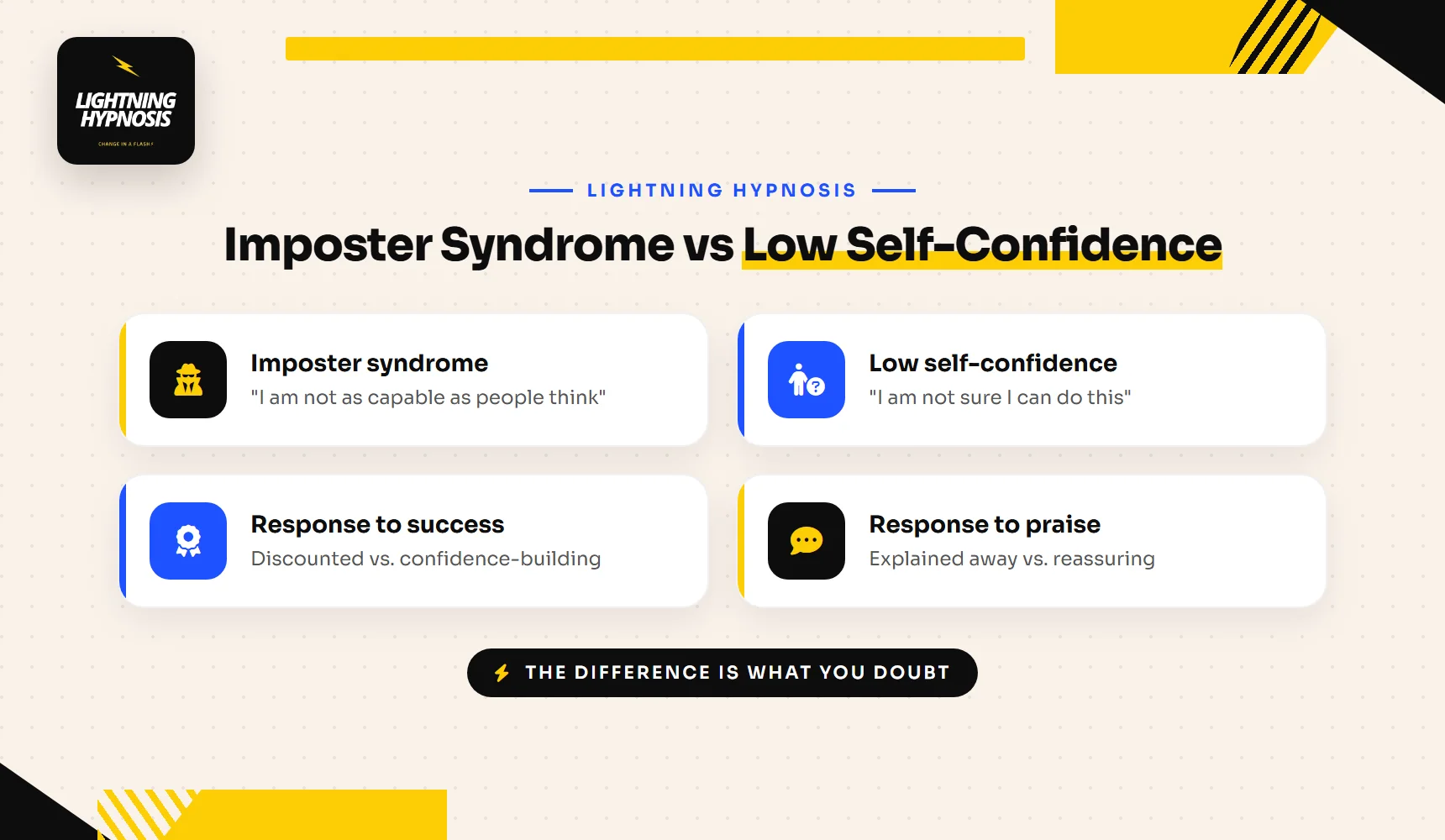
Imposter syndrome centers on doubting the legitimacy of your demonstrated success, while low self-confidence centers on doubting your ability to perform or succeed. The distinction often becomes clearest in how a person interprets achievement: confidence may increase after evidence of competence, while imposter feelings can persist despite that evidence.
| Imposter syndrome | Low self-confidence | |
|---|---|---|
| Core concern | “I am not as capable as people think.” | “I am not sure I can do this.” |
| Relationship with achievement | Success may feel undeserved or misleading | Success can provide evidence that builds confidence |
| Response to praise | Positive feedback may be discounted or explained away | Positive feedback may increase belief in ability |
| Typical focus | Legitimacy, competence, and deserving success | Ability to handle a task or situation |
| Common pattern | Fear of being exposed as less capable | Hesitation, avoidance, or uncertainty |
| Can occur despite success? | Yes, achievement can coexist with imposter feelings | Yes, although confidence may improve with experience and mastery |
How Does Imposter Syndrome Feel?
Imposter syndrome often creates a gap between external evidence of competence and internal perception. A person may earn a promotion, receive strong feedback, complete difficult work, or achieve a demanding goal yet still believe the outcome exaggerates their actual ability.
Success may be attributed to luck, timing, extra effort, an easy task, or help from others rather than personal competence. This attribution pattern makes achievements less effective at correcting self-doubt because the person continually finds reasons why each success does not count as valid evidence.
The underlying concern is often not simply whether the next task can be completed. It is whether other people have formed an inaccurate impression of the person's abilities and may eventually discover the perceived inadequacy.
How Does Low Self-Confidence Feel?
Low self-confidence is more directly connected to uncertainty about capability. Someone may question whether they can give a presentation, handle a new responsibility, learn a skill, make a difficult decision, or perform successfully in an unfamiliar setting.
Unlike imposter feelings, that uncertainty does not necessarily involve believing previous accomplishments were undeserved. The person may accurately recognize past successes while still feeling unprepared for a particular challenge.
Confidence can also be highly specific. Someone may feel capable at work but uncertain in social situations, or confident performing familiar tasks but hesitant when responsibilities change. Experience, skill development, successful practice, and repeated exposure can strengthen confidence when the underlying issue is uncertainty about ability.
Imposter Syndrome vs Self-Doubt vs Low Self-Esteem
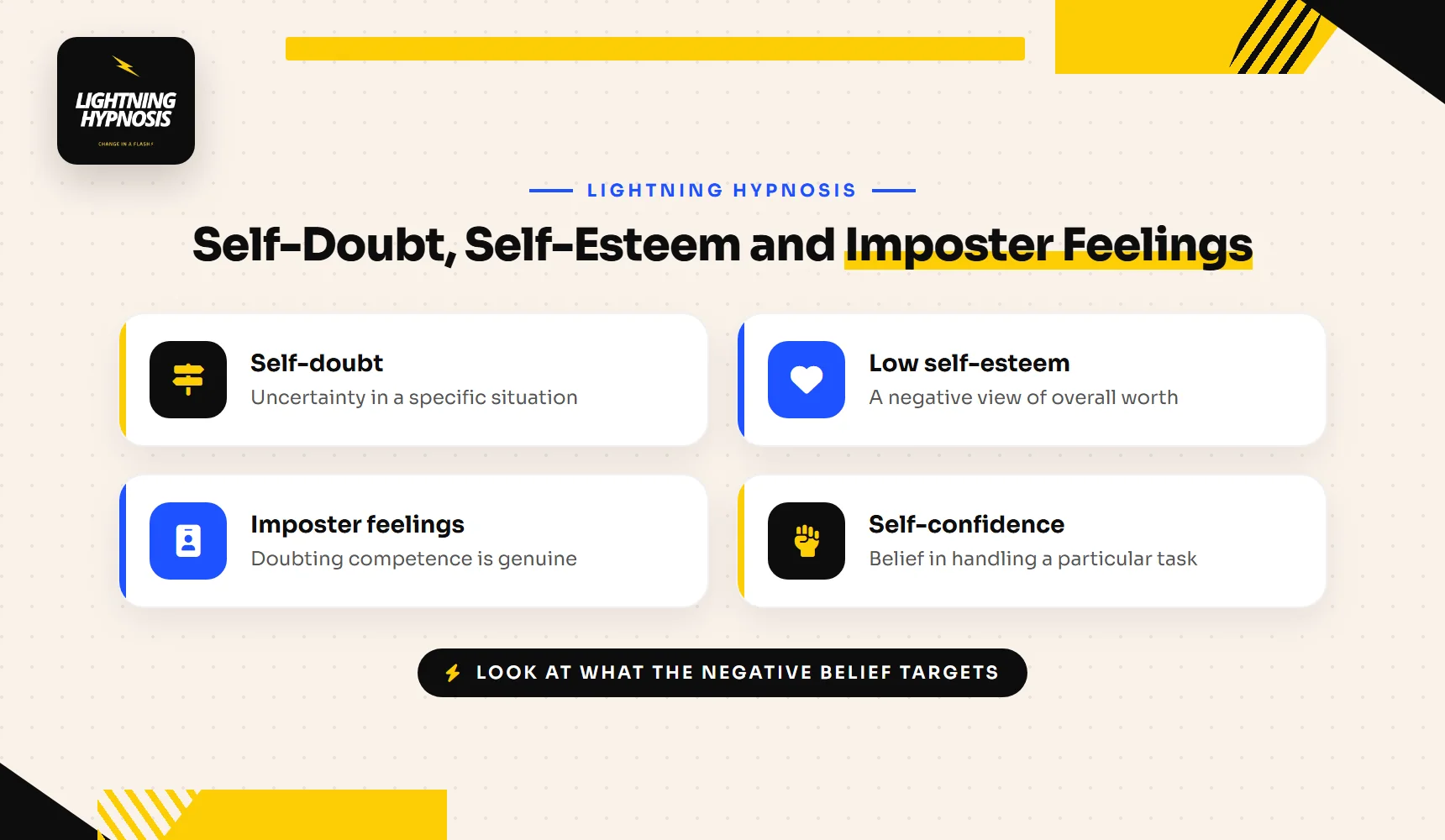
Imposter syndrome, self-doubt, and low self-esteem can occur together, but each describes a different psychological pattern. Separating them requires looking at what the negative belief targets: a specific decision, personal worth, or the legitimacy of competence and achievement.
Imposter Syndrome vs Self-Doubt
Self-doubt is uncertainty about your judgment, choices, or ability in a particular situation, while imposter syndrome involves a recurring difficulty accepting that your competence is genuine. Self-doubt can arise before an unfamiliar task, major decision, interview, examination, or new responsibility without becoming a persistent pattern.
Situational doubt can also be realistic. Limited experience or incomplete knowledge may give someone a valid reason to question whether they are ready. It often decreases once the person gains information, preparation, or experience.
Imposter feelings operate differently. The doubt can remain even when qualifications, performance, and repeated results provide strong evidence that the person belongs in the role or has earned the opportunity.
Imposter Syndrome vs Low Self-Esteem
Low self-esteem concerns how positively or negatively a person evaluates their overall worth, whereas imposter syndrome is more closely tied to perceived competence, legitimacy, and achievement. Someone with low self-esteem may hold negative beliefs about themselves across multiple areas of life, not only situations involving performance.
Imposter feelings can be narrower. A person may value themselves, maintain healthy relationships, and function confidently in other settings while questioning whether they deserve a professional, academic, or achievement-based position.
The two can still interact. When personal worth becomes heavily dependent on performance or external approval, mistakes and criticism may carry greater weight, making achievement-related doubts harder to separate from broader self-evaluation.
Low Self-Esteem vs Low Self-Confidence
Self-esteem reflects perceived personal worth, while self-confidence reflects belief in the ability to handle a particular task or situation. A person can therefore have healthy self-esteem while lacking confidence in public speaking, leadership, social interaction, or another unfamiliar skill.
The reverse is also possible. Someone may perform competently and trust their abilities in certain settings while maintaining a negative overall view of themselves. Recognizing which belief is affected prevents every form of insecurity from being treated as a confidence problem.
This distinction also matters when deciding what kind of support may be useful. For people in El Paso experiencing persistent patterns that extend beyond ordinary situational uncertainty, identifying whether the concern involves competence, self-worth, or imposter feelings can provide a clearer starting point for addressing it.
Signs You May Be Experiencing Imposter Syndrome Rather Than Just Low Confidence
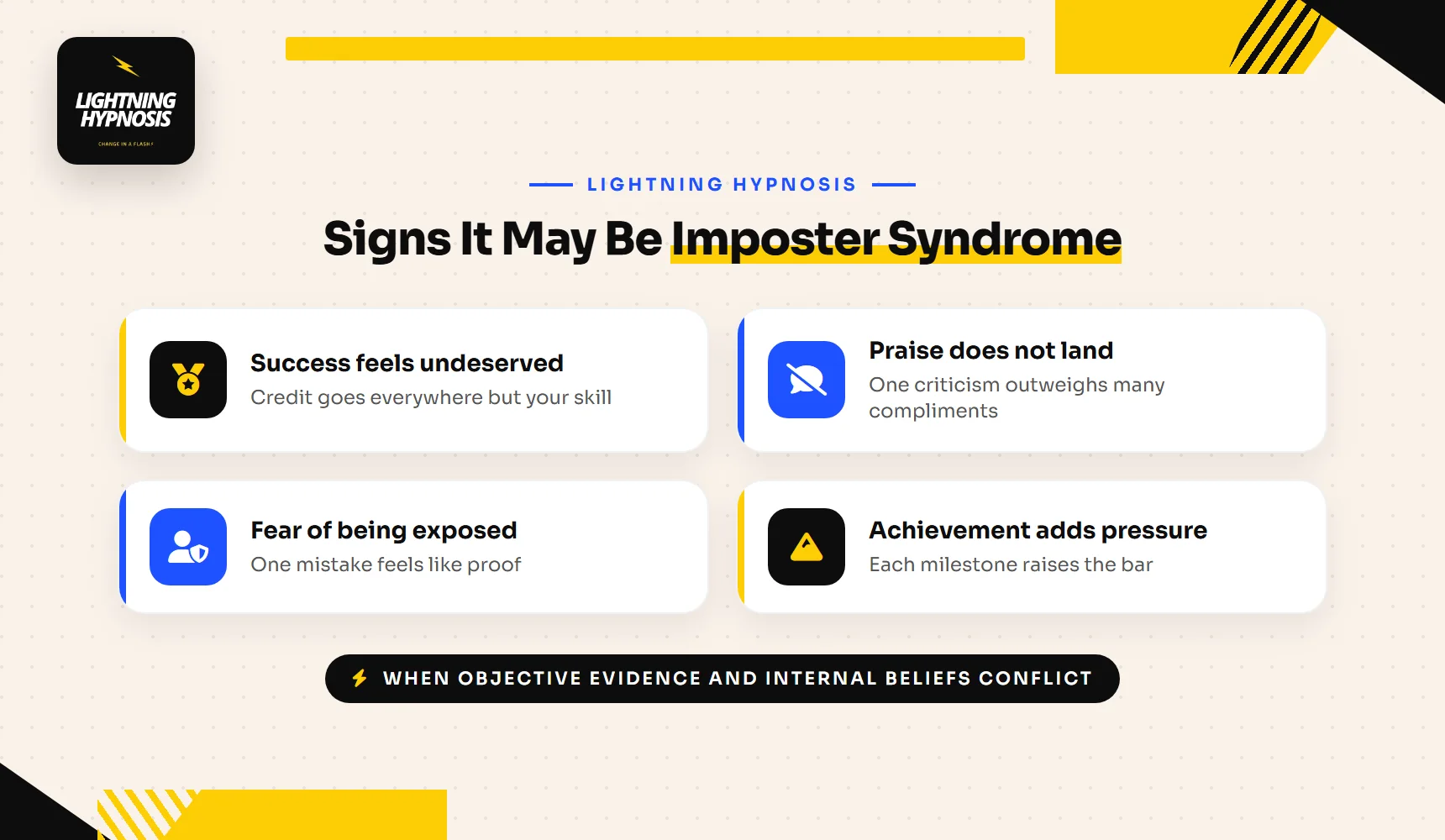
The clearest signs of imposter syndrome often appear when objective evidence and internal beliefs conflict. Instead of asking only whether you feel uncertain, look at how you interpret accomplishments, recognition, and expectations placed on you.
Success Still Feels Undeserved
A strong indicator is repeatedly finding explanations for success that exclude your own competence. You might credit an achievement to luck, good timing, an easy assignment, supportive colleagues, or unusually hard work while minimizing the skills that contributed to the outcome.
The pattern becomes more significant when it continues across multiple accomplishments. Each new result should provide evidence for updating your perception of your abilities, but consistently discounting that evidence can preserve the belief that you have not truly earned your position or recognition.
Praise Does Not Change Your Belief
Positive feedback can feel difficult to absorb when it conflicts with your internal assessment. Compliments may be dismissed as politeness, while strong evaluations or recognition may be interpreted as evidence that other people simply have not seen your limitations yet.
Pay attention to the imbalance between how you process positive and negative information. If praise is quickly rejected but one criticism is treated as confirmation of inadequacy, your self-assessment may be giving disproportionate weight to evidence that supports the imposter belief.
You Fear Being Exposed
Fear of exposure goes beyond worrying about making a mistake. It involves anticipating that a mistake, difficult question, or unfamiliar challenge could reveal that you never deserved your reputation, role, or opportunity in the first place.
This can create heightened vigilance around situations where performance is visible to others. Rather than viewing an error as one imperfect outcome, the person may interpret it as potential proof of a much broader perceived inadequacy.
Achievement Creates More Pressure
For some people, greater achievement does not produce greater psychological security. A promotion, new client, academic milestone, leadership responsibility, or public recognition can instead raise the perceived standard they must continue meeting.
That pressure may contribute to perfectionism, excessive preparation, reluctance to ask for help, or unusually high personal standards. The goal gradually shifts from performing well to preventing any evidence that could contradict the competent image others hold.
What Are the 5 Types of Imposter Syndrome?
The five commonly described types of imposter syndrome are the Perfectionist, Expert, Natural Genius, Soloist, and Superhuman. These profiles describe different ways imposter feelings may influence how people judge their competence, set expectations, and respond to challenges.
- The Perfectionist: Sets exceptionally high standards and may interpret anything short of an ideal result as evidence of inadequacy.
- The Expert: Believes they should know everything before considering themselves competent and may focus heavily on gaps in their knowledge.
- The Natural Genius: Expects competence to come quickly and may interpret needing significant effort, practice, or guidance as evidence that they lack ability.
- The Soloist: Places strong value on accomplishing tasks independently and may view asking for assistance as evidence that they are not capable enough.
- The Superhuman: Measures competence by the ability to perform exceptionally across multiple responsibilities and may feel inadequate when unable to excel in every area.
These types are useful frameworks for recognizing different imposter patterns, but they are not clinical diagnoses. A person may relate to more than one type, and the pattern can change across professional, academic, or personal situations.
Can You Have Imposter Syndrome and Still Be Confident?
Yes, you can experience imposter syndrome and still be confident. Confidence is often domain-specific, so feeling capable in one area does not prevent imposter feelings from appearing in another. A person may trust their social skills, decision-making, or technical abilities while questioning whether they genuinely deserve a particular role, achievement, or level of recognition.
The distinction can also appear between performing confidently and evaluating yourself confidently. An experienced professional may lead meetings, solve complex problems, or make difficult decisions effectively while privately questioning whether others have overestimated their expertise. Competent behavior does not automatically eliminate internal doubts about legitimacy.
Imposter feelings may become particularly noticeable when the context changes. A promotion, leadership position, competitive academic program, new professional environment, or increased responsibility can introduce a different comparison group and higher expectations. Someone who previously felt secure may begin comparing themselves with more experienced peers and interpret normal learning gaps as evidence that they do not belong.
For the same reason, healthy self-esteem does not necessarily rule out imposter feelings. A person can maintain a generally positive sense of self-worth while experiencing persistent doubts within a specific achievement-related domain.
The more useful question, therefore, is not simply “Am I confident?” but “Where does my confidence change, and what triggers that change?” Identifying whether the doubt is tied to a particular role, transition, or performance environment can clarify why confidence and imposter feelings sometimes exist at the same time.
What Should You Do About Imposter Syndrome or Low Self-Confidence?
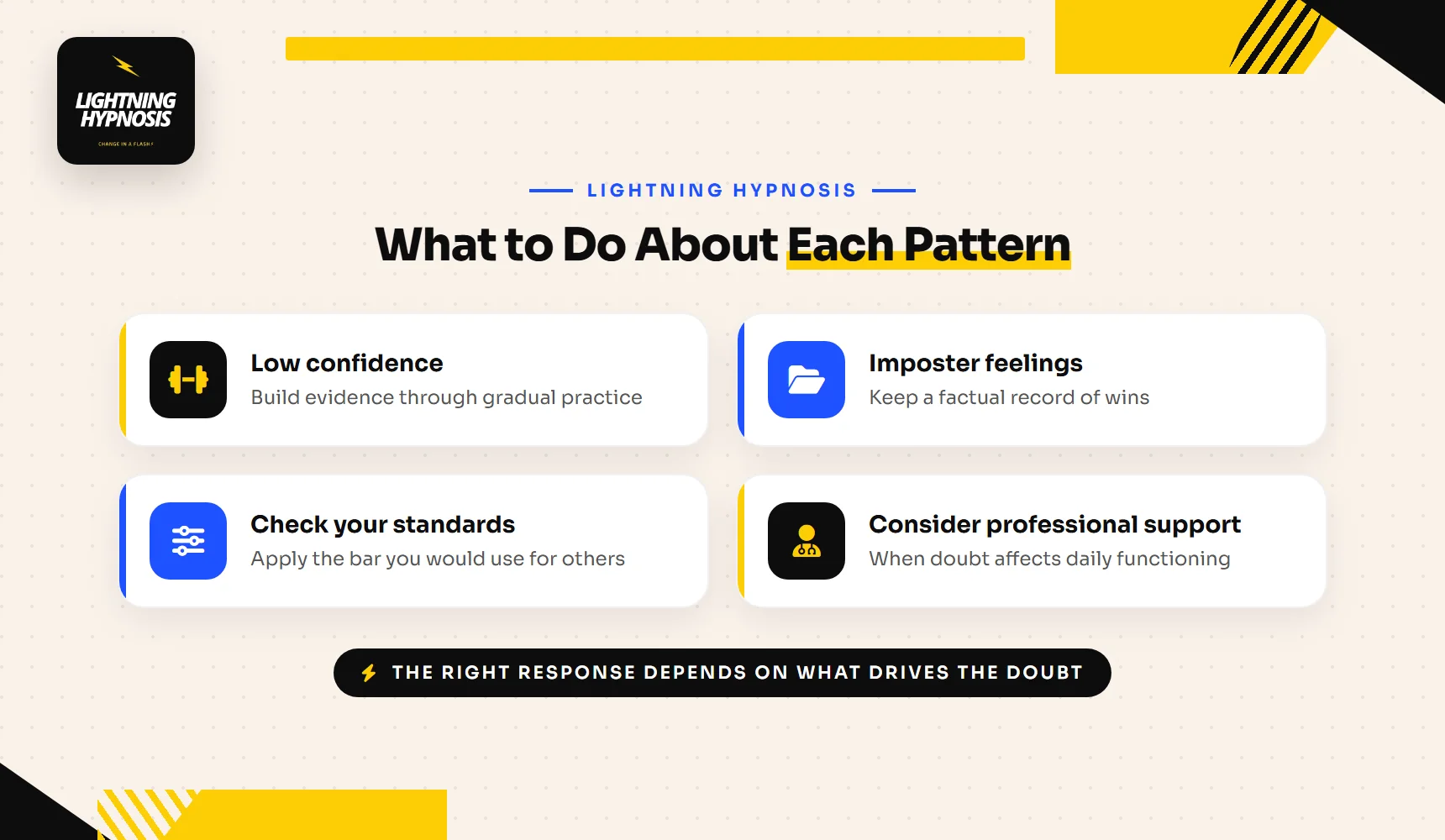
The most useful response depends on what is driving the doubt. A genuine confidence gap may require more experience or skill development, while imposter feelings often require examining how competence, mistakes, and achievements are interpreted.
When Low Confidence Is the Main Problem
When confidence is limited by inexperience or uncertainty, focus on building evidence through action. Break the challenging area into specific skills, practice them under gradually more demanding conditions, and track what improves over time.
For example, someone who lacks confidence speaking in meetings may start by contributing one prepared point, then progress to presenting a short update and eventually leading a discussion. This creates repeated evidence of capability rather than relying on reassurance alone.
Setbacks should also be evaluated specifically. A weak presentation may indicate that preparation, delivery, or subject knowledge needs work. It does not automatically establish a permanent lack of ability.
When Imposter Feelings Are the Main Problem
When competence already exists but still feels difficult to accept, collecting more achievements may not resolve the underlying pattern. Instead, examine how you explain your successes and failures.
Keep a factual record of completed goals, positive feedback, responsibilities earned, and problems successfully handled. When you attribute a positive result entirely to luck or outside help, identify the skills, decisions, preparation, and effort that also influenced the outcome.
Perfectionistic standards may need similar scrutiny. Competence does not require knowing everything, performing flawlessly, or never asking for assistance. Compare your expectations with the standards you would realistically apply to another capable person in the same position.
When Should You Consider Professional Support?
Professional support may be worth considering when persistent self-doubt, fear of failure, perfectionism, avoidance, or achievement-related anxiety begins affecting work, relationships, opportunities, or everyday functioning.
A qualified mental health professional can help identify whether the difficulty primarily involves confidence, self-esteem, anxiety, perfectionistic thinking, or recurring imposter feelings. That distinction can guide a more targeted approach rather than treating every form of self-doubt in the same way.
If imposter feelings continue to affect how you view your abilities and achievements, Lightning Hypnosis provides hypnotherapy for imposter syndrome for clients across the El Paso and Las Cruces region and surrounding communities in West Texas and Southern New Mexico.
Take the next step toward addressing the thought patterns behind persistent self-doubt and developing a more grounded view of your abilities. Contact Lightning Hypnosis to learn more or schedule a session.
Frequently Asked Questions
What are two signs of low self-esteem?
Two common signs of low self-esteem are persistent negative self-evaluation and difficulty recognizing your own strengths or value. It may also appear as excessive sensitivity to criticism, frequent comparison with others, people-pleasing, or avoiding situations where rejection is possible. Unlike low confidence in one skill, low self-esteem can affect how someone evaluates themselves more broadly.
What age is self-esteem lowest?
Self-esteem does not reach its lowest point at one universal age. Research suggests it generally increases from adolescence through much of adulthood, peaks around middle age, and may decline in later life. Individual experiences vary considerably, so age alone cannot determine whether someone will have low self-esteem or confidence problems.
What does a person with low self-esteem act like?
Low self-esteem can appear as frequent self-criticism, difficulty accepting compliments, excessive comparison, people-pleasing, indecisiveness, or avoiding situations where failure or rejection feels possible. Some people may also seek frequent reassurance. These behaviors are not proof of low self-esteem individually, since anxiety, stress, personality, and other factors can produce similar patterns.
Do I have imposter syndrome or am I just bad at something?
Difficulty with a task does not automatically mean you have imposter syndrome or lack ability. Look at the evidence. If skills or experience are genuinely limited, improvement may require learning and practice. If you repeatedly perform well but dismiss those results and continue believing others have overestimated your competence, the pattern is more consistent with imposter feelings.
What triggers imposter syndrome?
Imposter feelings can become more noticeable during situations involving increased expectations, evaluation, comparison, or unfamiliar responsibility. Common triggers include starting a new job, receiving a promotion, entering a competitive environment, taking on leadership, or achieving greater recognition. Perfectionistic standards and comparing yourself with highly accomplished peers can intensify these doubts.
Can imposter syndrome be mistaken for low self-confidence?
Yes. Both can involve hesitation and self-doubt, but the underlying pattern differs. Low confidence often reflects uncertainty about whether you can perform a task, while imposter syndrome can persist despite demonstrated competence. Looking at how you interpret previous achievements, rather than simply how confident you feel, can make the distinction clearer.