
Can Hypnotherapy Help With Fear of Public Speaking?
Fear of public speaking is one of the most common fears, and one of the most inconvenient, because avoiding it usually means avoiding the meeting, the presentation, or the promotion attached to it.
Hypnotherapy comes up often in searches for a solution, and most of what is written about it comes from practitioners who sell it. This article takes a different approach. It covers what the fear actually is, what the research supports as treatment, what the evidence on hypnotherapy genuinely shows, and where it fits honestly alongside the approaches with stronger backing.
The short answer is that hypnotherapy has one encouraging trial and an insufficient overall evidence base for treating anxiety. That does not make it useless, but it does change what it can reasonably be expected to do.
Key Takeaways
Public speaking fear is a normal threat response. The clinically meaningful line is avoidance, not intensity, so nerves you push through differ from a fear that changes your decisions.
CBT and graduated exposure carry the strongest evidence, and most clinical guidelines list CBT first. Any assessment of hypnotherapy has to be made against that baseline.
A systematic review indexed by the NIH found the evidence insufficient to support hypnosis for anxiety. One trial within it did show improvement in performance-related social phobia specifically.
Hypnotherapy's clearest use is lowering physical arousal and rehearsing the situation. Neither addresses the underlying prediction that something will go wrong, which is what CBT targets.
What Public Speaking Fear Actually Is
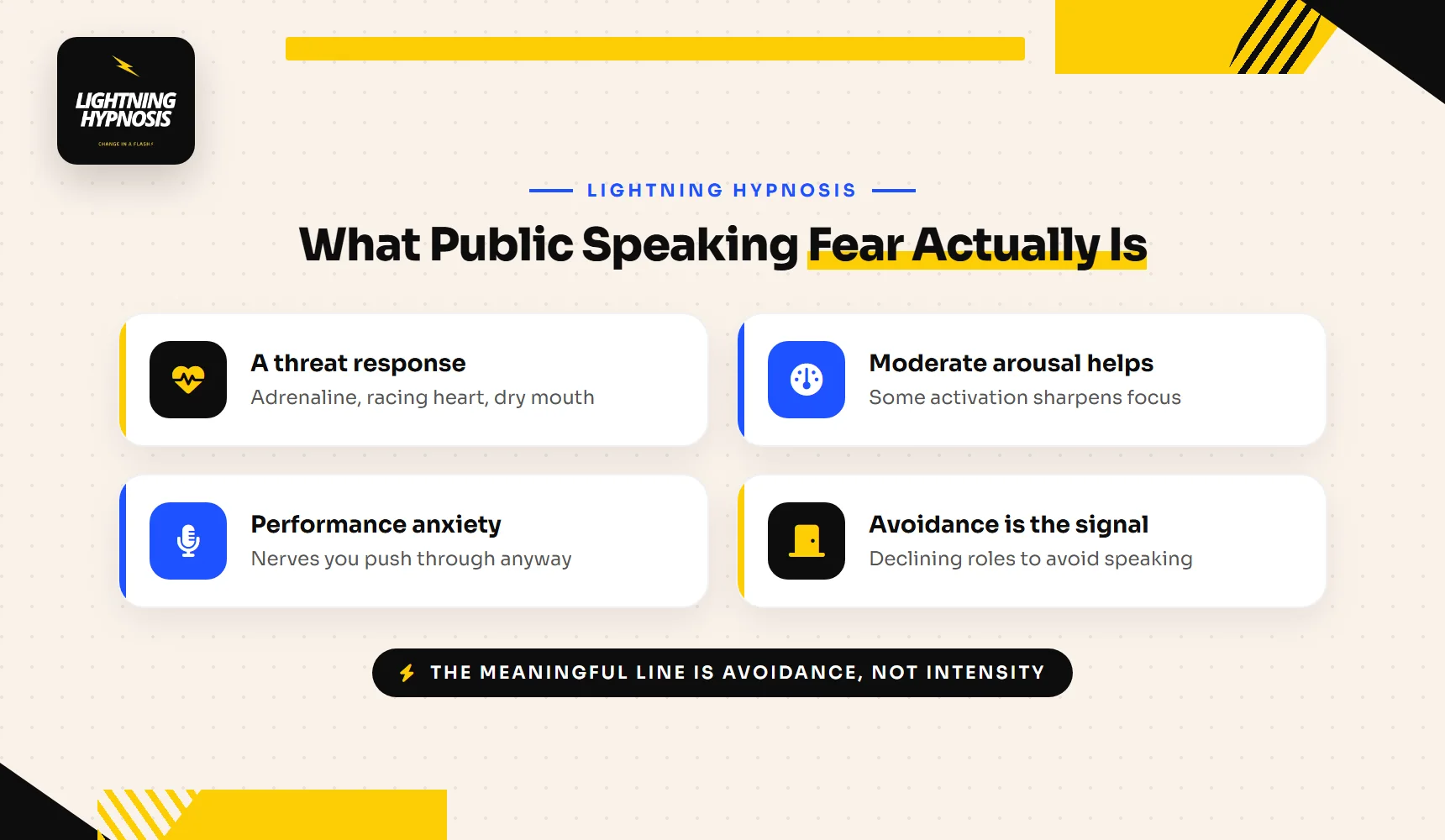
Public speaking fear is a threat response aimed at a situation that is not physically dangerous. The body reacts as though it is.
The mechanism is ordinary. Standing in front of an audience triggers the same sympathetic nervous system activation that any perceived threat produces: adrenaline release, elevated heart rate, shallow breathing, dry mouth, tremor, sweating, and a narrowing of attention. None of that is malfunction. It is a system doing what it evolved to do, applied to a situation where being watched and judged registers as risk.
Most people experience some version of this, and moderate arousal is not the enemy. A degree of activation sharpens focus and is present in experienced speakers who describe themselves as comfortable. The problem is not the response existing. It is the response scaling past the point where it can be worked with.
The clinically meaningful threshold is avoidance. Nerves before a presentation that you deliver anyway is performance anxiety. Turning down roles, changing career paths, calling in sick, or restructuring your working life to avoid speaking is a different order of problem, and it is where social anxiety disorder begins to be the more accurate description.
That distinction matters more than anything else in this article, because it determines which approach makes sense. Someone with manageable nerves before quarterly presentations and someone who has declined two promotions to avoid presenting are describing different situations, and the second needs a clinician rather than a technique.
Treatments With the Strongest Evidence for Speaking Anxiety
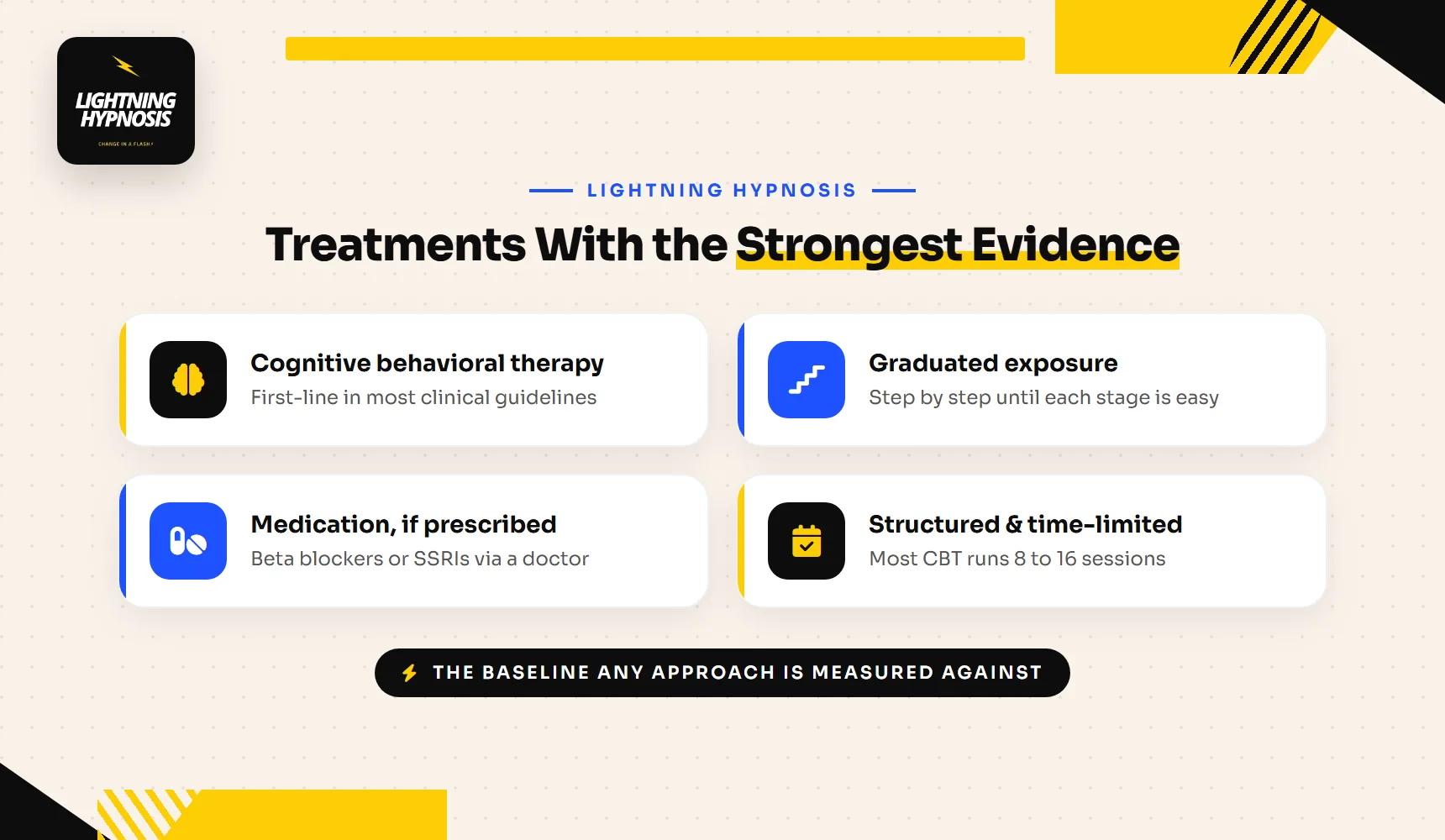
Before assessing hypnotherapy, it is worth knowing what it would be compared against. Two approaches carry substantially more research support than anything else, and both are widely available.
Why Cognitive Behavioral Therapy Is Considered First-Line
CBT is the most extensively studied treatment for social and performance anxiety, and it is what most clinical guidelines recommend first.
The approach targets the thinking that maintains the fear rather than the fear itself. Someone anxious about presenting typically holds specific predictions: that they will visibly shake, that their mind will go blank, that the audience will notice and judge them, and that the consequences will be lasting. CBT identifies those predictions, tests them against what actually happens, and works on the attention pattern that keeps focus turned inward on your own symptoms rather than outward on the material and the room.
It is structured and time-limited. Most protocols run somewhere between eight and sixteen sessions, with work between them. That is a real commitment, and it is also why the effects tend to hold after treatment ends rather than requiring ongoing sessions.
How Graduated Exposure Reduces the Response
Exposure is usually delivered within CBT and is the component doing much of the work.
The principle is that avoidance maintains fear. Every presentation successfully avoided confirms to the nervous system that the threat was real and that avoidance was the correct response, which strengthens the pattern. Exposure reverses this by working through a graded sequence, starting with situations that produce manageable anxiety and progressing only once each step stops being difficult.
For public speaking, that might run from speaking aloud alone, to speaking to one trusted person, to a small familiar group, to an unfamiliar audience. The sequence is deliberately incremental, and the mechanism is habituation rather than willpower. The response reduces because the nervous system accumulates evidence that the predicted disaster does not occur.
When Medication Becomes Part of the Picture
Medication is a legitimate option for some people and a decision for a doctor rather than an article.
Two broad categories come up. Beta blockers are sometimes prescribed situationally for performance anxiety and act on the physical symptoms, reducing tremor and racing heart without affecting the thinking behind them. SSRIs are prescribed for social anxiety disorder as an ongoing treatment rather than a situational one.
Both require a prescription and a conversation about suitability, interactions, and side effects. Neither is something to source informally, and beta blockers in particular are contraindicated for several common conditions, including asthma.
What the Research Says About Hypnotherapy
This is the question the article exists to answer, and the honest answer is more qualified than most pages on this topic suggest.
One Encouraging Trial and an Insufficient Evidence Base
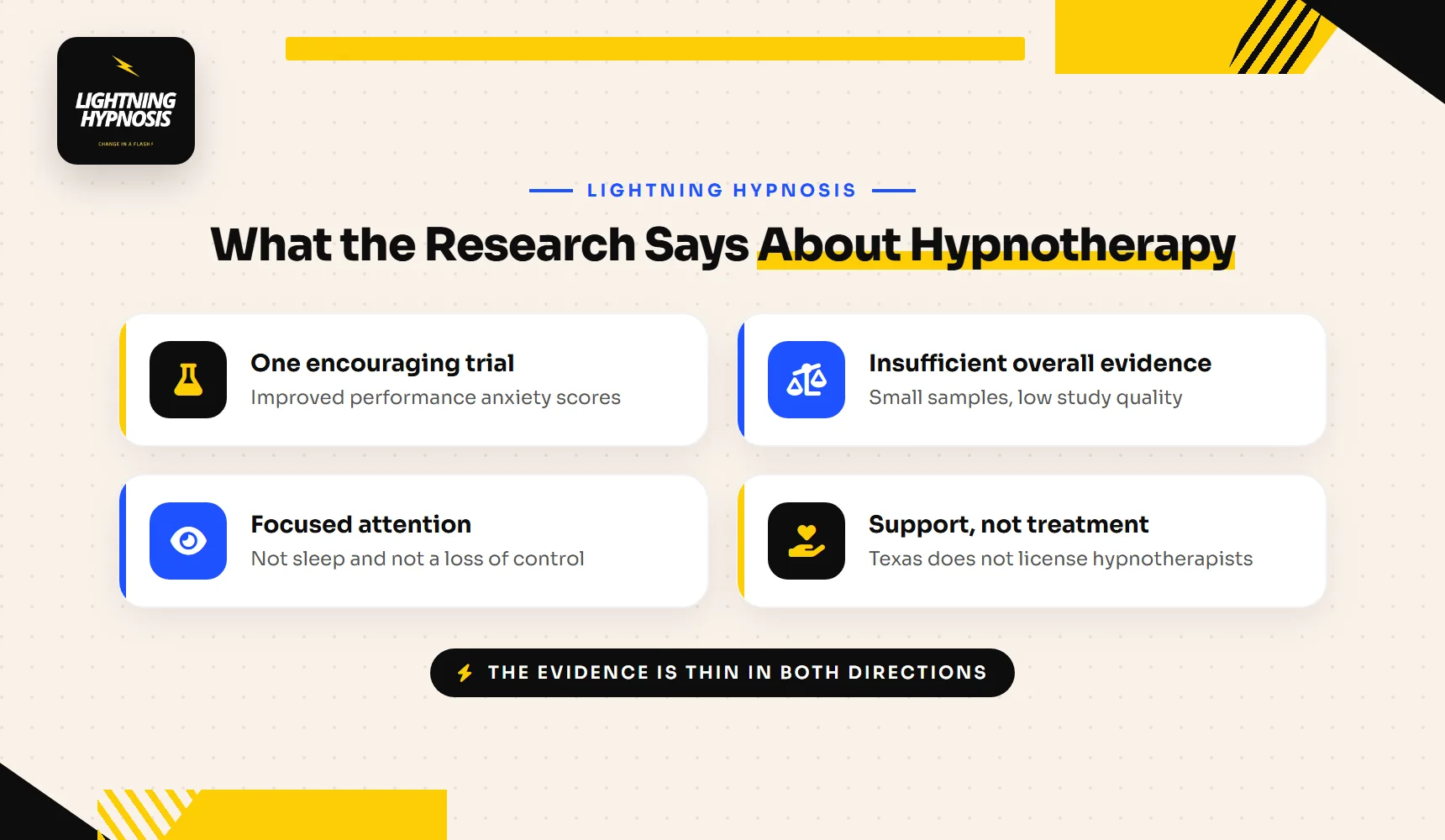
A systematic review of randomized controlled trials, indexed in the NIH's Database of Abstracts of Reviews of Effects, concluded that the available evidence was insufficient to support hypnosis for treating anxiety. The trials that existed had small samples and low methodological quality, and the review authors noted this raises ethical questions for practitioners offering hypnotherapy as anxiety treatment.
Within that same review, one trial is directly relevant here. It measured performance-related social phobia specifically and found a significant improvement in Performance Anxiety Inventory scores for the hypnosis group compared with a control condition.
Both of those things are true at once. There is a positive finding pointing at exactly the application this article is about, and the overall body of evidence is not strong enough to draw conclusions from. One trial is a reason to investigate further, not a reason to claim efficacy.
What this means practically is that anyone telling you hypnotherapy is a proven treatment for public speaking fear is overstating the research. Anyone telling you it has been shown to be useless is also overstating it. The accurate position is that the evidence is thin in both directions.
What Actually Happens in a Hypnotherapy Session
Hypnosis is a state of focused attention with reduced peripheral awareness and increased responsiveness to suggestion. It is not sleep, and it is not a loss of control or awareness.
A session for performance anxiety typically involves guided relaxation to lower physical arousal, then suggestion and mental rehearsal directed at the situation you are anxious about. The practitioner may walk you through delivering a presentation calmly while you are in that focused state, with the aim of altering the automatic response the situation triggers.
The overlap with established techniques is worth noticing. Guided relaxation, visualization, and mental rehearsal all appear in sports psychology and in CBT, and none of them is unique to hypnotherapy. What hypnosis adds is the suggestibility of the focused state, and whether that addition produces a meaningfully better result is precisely what the research has not established.
Why the Difference Between Support and Treatment Matters
The distinction is not a technicality. It determines what you should expect and who you should be seeing.
Treatment implies an evidence-based intervention delivered by a licensed clinician for a diagnosed condition. Support means an approach that may help you manage a difficulty, offered by someone who is not diagnosing or treating anything. Hypnotherapists in most states, including Texas, are not licensed mental health providers, and reputable practitioners say so directly.
That matters in one specific scenario. Someone with genuine social anxiety disorder who spends six months on hypnotherapy sessions has spent six months not receiving the treatment with the strongest evidence behind it. The risk is not that hypnotherapy causes harm. It is the delay.
For ordinary performance nerves, the calculation is different, and Section 4 covers where it reasonably fits.
Where Hypnotherapy Reasonably Fits
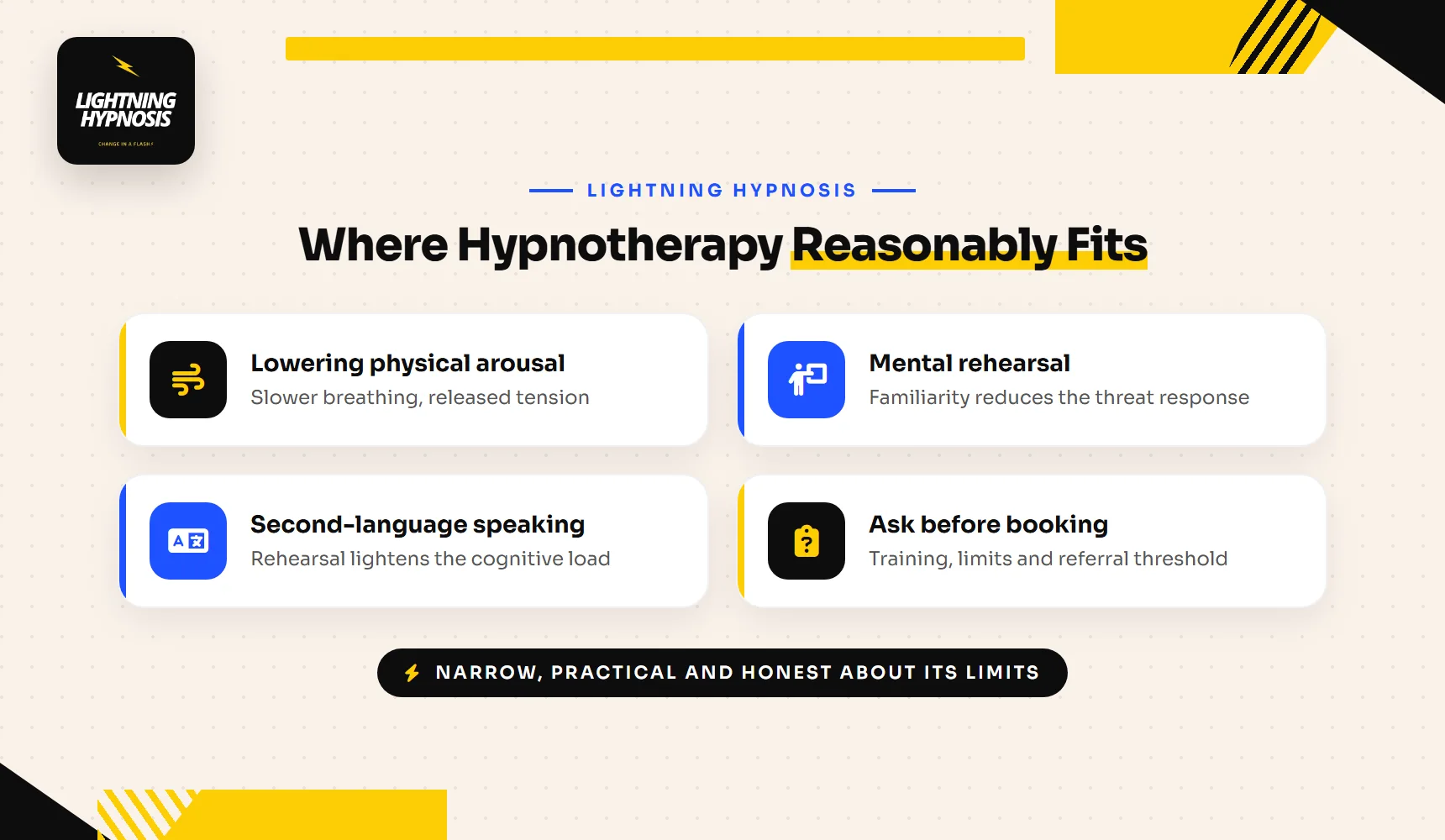
Given all of that, there is still a legitimate role. It sits in a narrower place than most practitioners claim, and it is worth being specific about what that place is.
Managing Physical Arousal Before You Speak
The clearest application is the body rather than the belief.
Guided relaxation reliably lowers sympathetic activation, and that effect is not in dispute regardless of what the anxiety literature concludes about treatment outcomes. Slower breathing, reduced heart rate, and released muscle tension are measurable, and they are what most people actually want in the twenty minutes before they present.
This is also the most transferable part. A practitioner will usually teach a self-hypnosis or self-relaxation technique you can use independently, which means the benefit does not depend on booking a session before every presentation. This is the narrow, practical end of what hypnotherapy for confidence offers, and it is worth asking for directly if it is not proposed.
What this does not do is change the underlying prediction that something will go wrong. Lowering arousal makes the response more manageable. It does not address the thinking generating it, which is what CBT targets.
Rehearsal, Visualization, and Habitual Responses
The second application is mental rehearsal, and it is genuinely useful.
Repeatedly rehearsing a situation while relaxed builds familiarity, and familiarity reduces threat response. Athletes and performers use this routinely. Hypnotherapy delivers it in a focused state, which practitioners argue makes the rehearsal more vivid and the suggestion more effective, though that specific claim is where the evidence runs out.
Language adds a layer worth naming in El Paso, where a substantial part of professional life runs bilingually, and many people present in their second language. Speaking under pressure in a second language raises cognitive load, and higher load means more hesitation, more self-monitoring, and more of the inward attention that drives performance anxiety. Rehearsal helps more here than it does in a first language, because familiarity with the specific words you plan to use removes part of the load before you stand up.
There is a related use for habitual reactions that sit alongside the fear rather than being the fear itself. Sleep disruption before a presentation, a specific physical habit under stress, or an avoidance routine that has become automatic are all narrower targets than the anxiety as a whole, and narrower targets are where this kind of work is most defensible. Presentation-related sleep loss in particular is closer to what hypnotherapy for insomnia addresses than to anxiety treatment.
Questions to Ask a Hypnotherapist Before Booking
Hypnotherapy is unregulated in most states, including Texas, which means the practitioner matters more than the method.
Ask these before booking:
- What is your training and certification, and through which body? Certification is voluntary, so ask which organization and what it requires.
- Are you a licensed mental health professional? Most are not, and a straight answer is the point, not the credential.
- What do you claim this can and cannot do? Anyone describing it as a cure or a proven treatment for anxiety is not representing the research accurately.
- When would you refer someone to a clinician instead? A practitioner without a clear answer does not have a referral threshold.
- Will you teach me a technique I can use myself? This separates a practitioner building your independence from one building a booking schedule.
A good practitioner will answer all five without defensiveness, and several will volunteer the limitations before you ask.
When Public Speaking Fear Needs a Clinician
Some presentations of this fear are outside what any non-clinical approach should be handling. Recognizing which is the most useful thing this article can offer.
Signs Your Fear May Be Social Anxiety Disorder
The distinguishing feature is scope and impact rather than intensity. Severe nerves before a big presentation are common. A fear that reshapes your decisions is different.
Speak to a clinician if you recognize several of these:
- Turning down roles, promotions, or opportunities specifically to avoid speaking
- Anxiety that begins days or weeks before an event rather than shortly before it
- The fear extending beyond formal presentations into meetings, phone calls, or introductions
- Physical symptoms severe enough to prevent you delivering at all
- Alcohol or unprescribed medication used to get through speaking situations
- Persistent low mood or hopelessness alongside the anxiety
The last one deserves particular attention. Social anxiety and depression frequently occur together, and the presence of both changes what treatment is appropriate.
What a First Appointment Involves
A first appointment with a primary care physician or a therapist is usually straightforward and shorter than people expect.
Expect questions about when the fear started, which situations trigger it, what you avoid because of it, how it affects your work and relationships, and whether anything else is going on with mood or sleep. A physician may also check for physical contributors, since thyroid problems and certain medications can produce symptoms that resemble anxiety.
You do not need a diagnosis before booking, and you do not need to have exhausted other options first. Being able to describe specifics helps more than having a label ready.
Preparation is easier when the physical response is under control. Lightning Hypnosis offers hypnotherapy across El Paso and the surrounding communities in West Texas and Southern New Mexico, working with relaxation, mental rehearsal, and the habitual reactions that build before you speak. Sessions support confidence alongside professional care rather than in place of it. Contact our team to arrange a free consultation.
Frequently Asked Questions
How many hypnotherapy sessions would this take?
Practitioners commonly quote three to six sessions for performance anxiety, though no research establishes an effective course length for this application. Ask what happens if you see no change after two or three, since a practitioner without an answer has no plan beyond continuing to book you.
Can you be hypnotized against your will?
No. Hypnosis requires cooperation and focused attention, and people retain awareness and the ability to stop at any point. Suggestibility varies between individuals, which is one reason results vary, but nobody can be put into a state they are resisting.
Is hypnotherapy regulated in Texas?
Texas does not license hypnotherapists. Certification is voluntary and issued by private organizations with differing standards, so ask which body certified a practitioner and what it required. Anyone offering hypnotherapy is not a licensed mental health provider unless they hold a separate clinical license.
Will beta blockers stop the fear or just the symptoms?
Beta blockers act on the physical response, reducing tremor and heart rate without addressing the thinking behind the fear. That suits situational performance anxiety and does not treat social anxiety disorder. They require a prescription and are contraindicated with asthma and several other conditions.
Does hypnotherapy work if you do not believe in it?
Suggestibility rather than belief predicts response, and the two are not the same thing. Skepticism does not prevent the relaxation component working, since guided relaxation lowers physical arousal regardless of expectation. Active resistance to the process is a different matter.