
How Hypnotherapy Helps Break Unwanted Habits
An unwanted habit can happen almost before a person realizes a choice was available. Nail biting during traffic, stress eating after work, or delaying an uncomfortable task may provide momentary relief, but that relief quietly reinforces the same response.
For people in El Paso, hypnotherapy offers a structured way to examine these automatic patterns and practice a different response. This article explains how hypnosis works with habit triggers, reinforcement, and behavioral change without relying on willpower alone.
Key Takeaways
Hypnosis creates focused attention rather than unconsciousness or loss of control.
Sessions examine the emotional, situational, and sensory cues that activate a habit.
Therapeutic suggestions reinforce a specific replacement behavior when familiar triggers arise.
Self-hypnosis and between-session practice help transfer new responses into daily routines.
Results vary, and medically harmful or addiction-related behaviors may require additional clinical care
Why Do Unwanted Habits Continue Despite Conscious Effort?
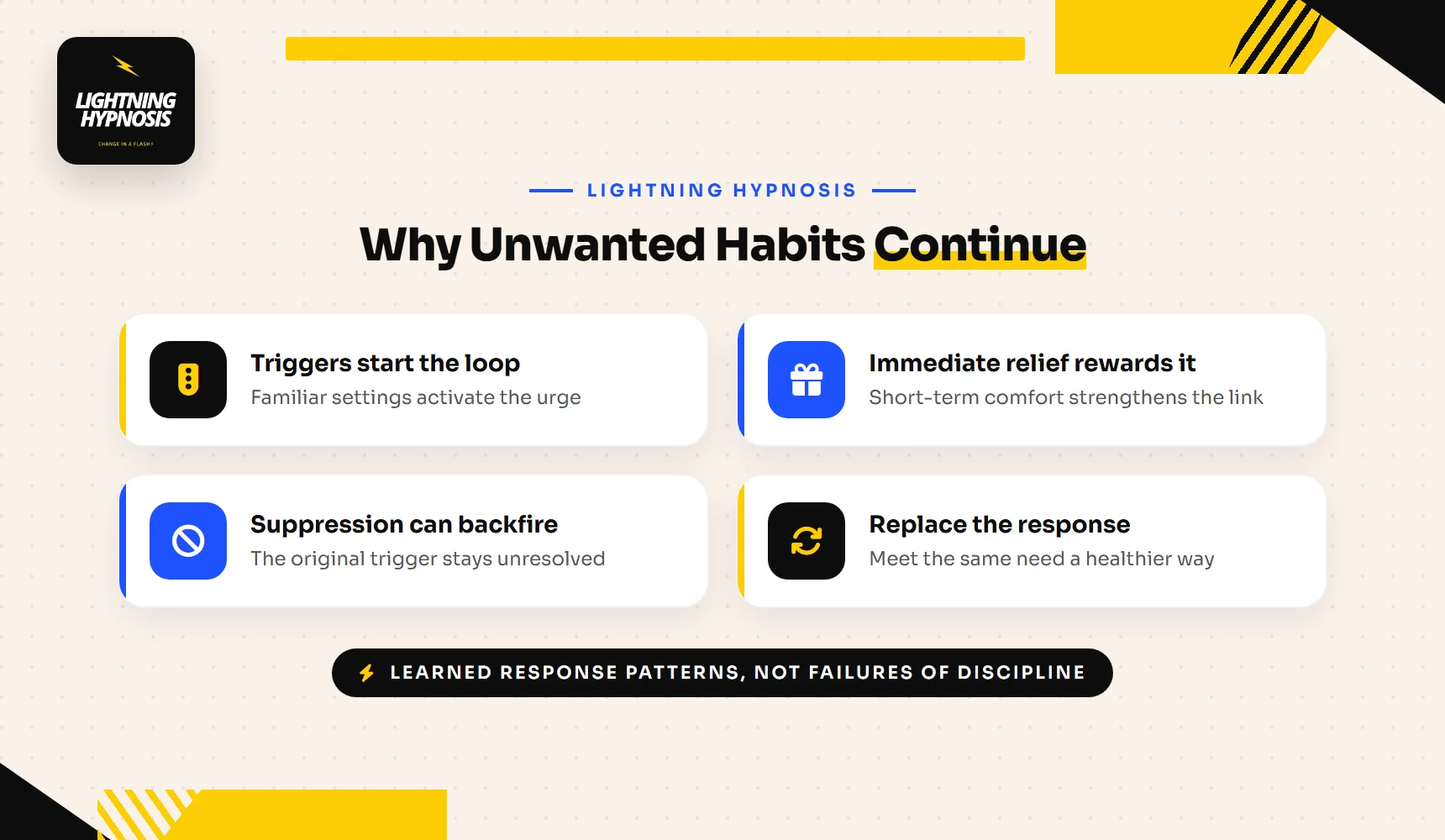
Unwanted habits persist because they operate as learned response patterns rather than simple failures of discipline. Once the brain connects a familiar trigger with a behavior that delivers an immediate reward, the action can begin before conscious reasoning has time to intervene.
How Triggers Activate Automatic Responses
A familiar environment can become part of a habit loop even when it has no direct connection to the behavior. In El Paso, someone who repeatedly bites their nails when traffic slows on I-10 may eventually feel the urge as soon as they enter the same route. Another person may associate waiting at an international bridge, finishing a late shift, or returning indoors after a hot afternoon with snacking, skin picking, or scrolling through a phone.
The important factor is predictability, not the city itself. When the same setting and emotional state repeatedly precede a behavior, details such as brake lights, waiting in line, or arriving home can begin activating the response. Identifying these precise moments gives hypnotherapy a defined cue to address instead of the vague goal of simply stopping a habit.
How Immediate Relief Reinforces the Habit
Most persistent habits provide a rapid benefit. Nail biting may release physical tension, procrastination may postpone discomfort, and stress eating may create temporary emotional relief. This immediate reward strengthens the connection between the trigger and the response.
The delayed disadvantages, such as frustration, embarrassment, discomfort, or lost productivity, usually have less influence in the moment. The brain learns from the immediate relief, which is why sincere motivation may not be enough to stop the pattern.
Why Suppressing the Behavior Can Lead to Relapse
Trying to block a habit without replacing its function leaves the original trigger unresolved. A person may resist nail biting, for example, while the tension that prompted it continues building. Under fatigue or stress, the familiar response can return because it remains the most practiced route to relief.
Effective habit change therefore requires more than stopping an action. It involves recognizing the cue, understanding the reward, and rehearsing a healthier response that can meet the same need without producing the unwanted consequence.
How Does Hypnotherapy Work on an Unwanted Habit?
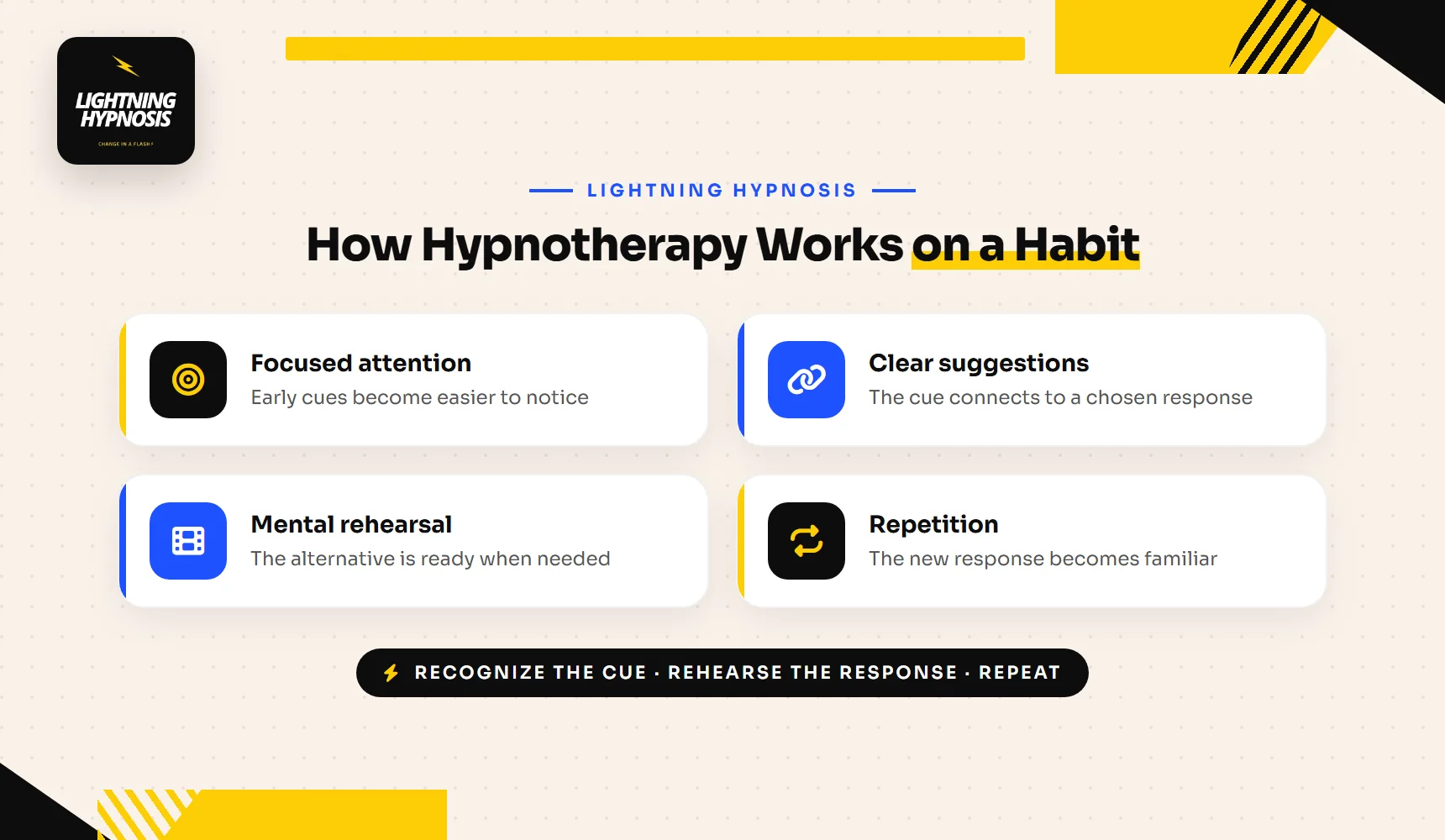
Hypnotherapy uses focused attention, carefully worded suggestions, and mental rehearsal to make an automatic behavior easier to recognize and interrupt. It does not erase the habit or remove personal control. Instead, it helps the client practice a specific response that can replace the familiar action when the urge appears.
According to the American Psychological Association, approximately 10% to 20% of people show low hypnotic responsiveness, while a similar proportion are highly responsive. Most people fall between these groups, indicating that hypnotic responsiveness varies between individuals.
Focused Attention Makes Early Cues Easier to Notice
Habitual behavior often begins with a subtle sensation, thought, or movement that receives little conscious attention. Focused attention allows the client to examine these early signals more closely. Becoming aware of the first stage of the urge creates an opportunity to respond before the familiar behavior is fully underway.
The goal is not constant self-monitoring. It is to recognize the earliest useful point at which the automatic sequence can be interrupted.
Suggestions Connect the Cue With a Chosen Response
Hypnotic suggestions are most useful when they describe a clear action rather than simply instructing someone to stop. The familiar cue may be connected with relaxing the hands, taking a controlled breath, changing position, or beginning one manageable part of an avoided task.
These suggestions do not force behavior. They give the client a prepared alternative that can be recalled when the original trigger appears.
Mental Rehearsal Makes the Alternative More Accessible
Mental rehearsal allows the client to imagine encountering the usual trigger, noticing the urge, pausing, and completing the planned response. With a clearly defined habit as the focus, clients using hypnotherapy can rehearse that response before the same situation arises in daily life.
The purpose is to reduce uncertainty at the critical moment. Instead of trying to invent a response while already experiencing the urge, the client has a familiar action ready to use.
Repetition Helps the New Response Become Familiar
A single interruption does not necessarily undo a pattern developed through repeated reinforcement. The alternative response becomes more accessible when it is rehearsed consistently and used whenever the relevant cue appears.
Progress may begin with noticing the urge earlier, delaying the behavior, or reducing its frequency. Over time, repeated use of the alternative can weaken the expectation that the trigger must always lead to the old response.
Which Unwanted Habits May Be Addressed With Hypnotherapy?
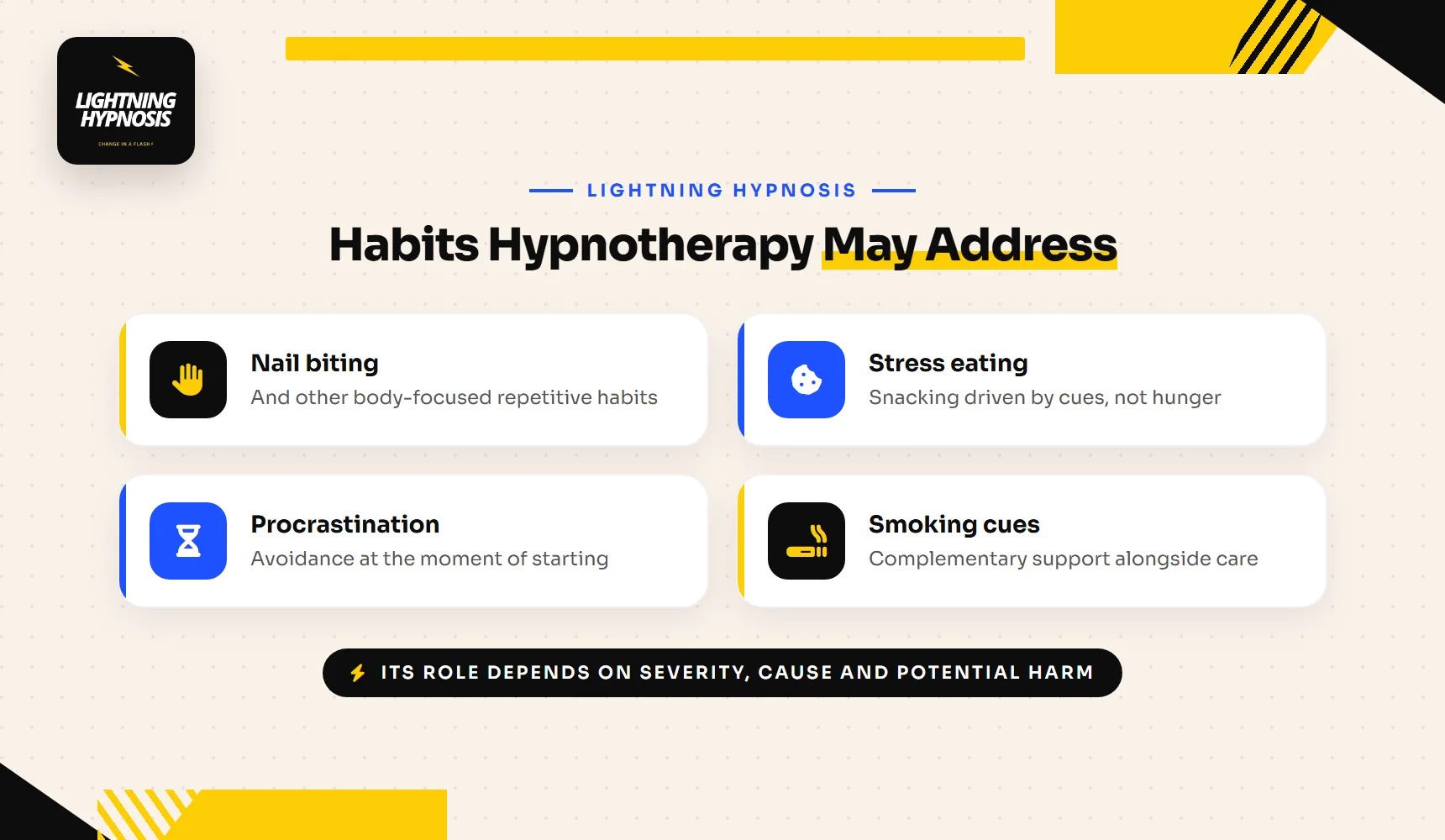
Hypnotherapy may be considered for repetitive behaviors influenced by identifiable cues, learned expectations, and short-term emotional rewards. Its appropriate role depends on the habit’s severity, underlying cause, and potential for physical or psychological harm.
Nail Biting and Body-Focused Repetitive Behaviors
Nail biting often occurs during concentration, boredom, anticipation, or tension. Because the movement can begin outside full awareness, hypnotherapy may focus on noticing early sensations in the fingers, jaw, or hands before contact occurs.
The replacement response might involve relaxing the hands, changing their position, breathing slowly, or using a harmless competing action. Skin picking and hair pulling require greater caution because persistent cases may represent body-focused repetitive behavior disorders that need evaluation by a licensed mental health professional.
Stress Eating and Unplanned Snacking
Hypnotherapy may help when eating is consistently triggered by boredom, stress, environmental cues, or a learned routine rather than physical hunger. Sessions can focus on distinguishing hunger from emotional discomfort, pausing before eating, and choosing another response to the original trigger.
It should not be presented as a guaranteed weight-loss method. Binge eating, purging, severe food restriction, or significant weight changes require assessment by qualified medical and eating-disorder professionals.
Procrastination and Avoidance Patterns
Procrastination often provides immediate escape from uncertainty, frustration, or fear of poor performance. Hypnotherapy can target the moment avoidance begins by rehearsing a smaller starting action, reducing catastrophic expectations, and linking task initiation with a manageable sense of control.
For someone delaying paperwork, study responsibilities, household tasks, or professional projects, the therapeutic target should be one observable behavior rather than the vague goal of becoming more productive.
Smoking and Dependence-Related Behaviors
Hypnotherapy may be used as complementary support for changing smoking cues, routines, and expectations. However, current evidence does not establish hypnosis as more effective than other cessation support or quitting without assistance.
Nicotine dependence may require behavioral counseling, medication, nicotine-replacement therapy, or quitline support. Hypnotherapy should complement appropriate treatment rather than replace it.
What Happens During a Habit-Focused Hypnotherapy Session?
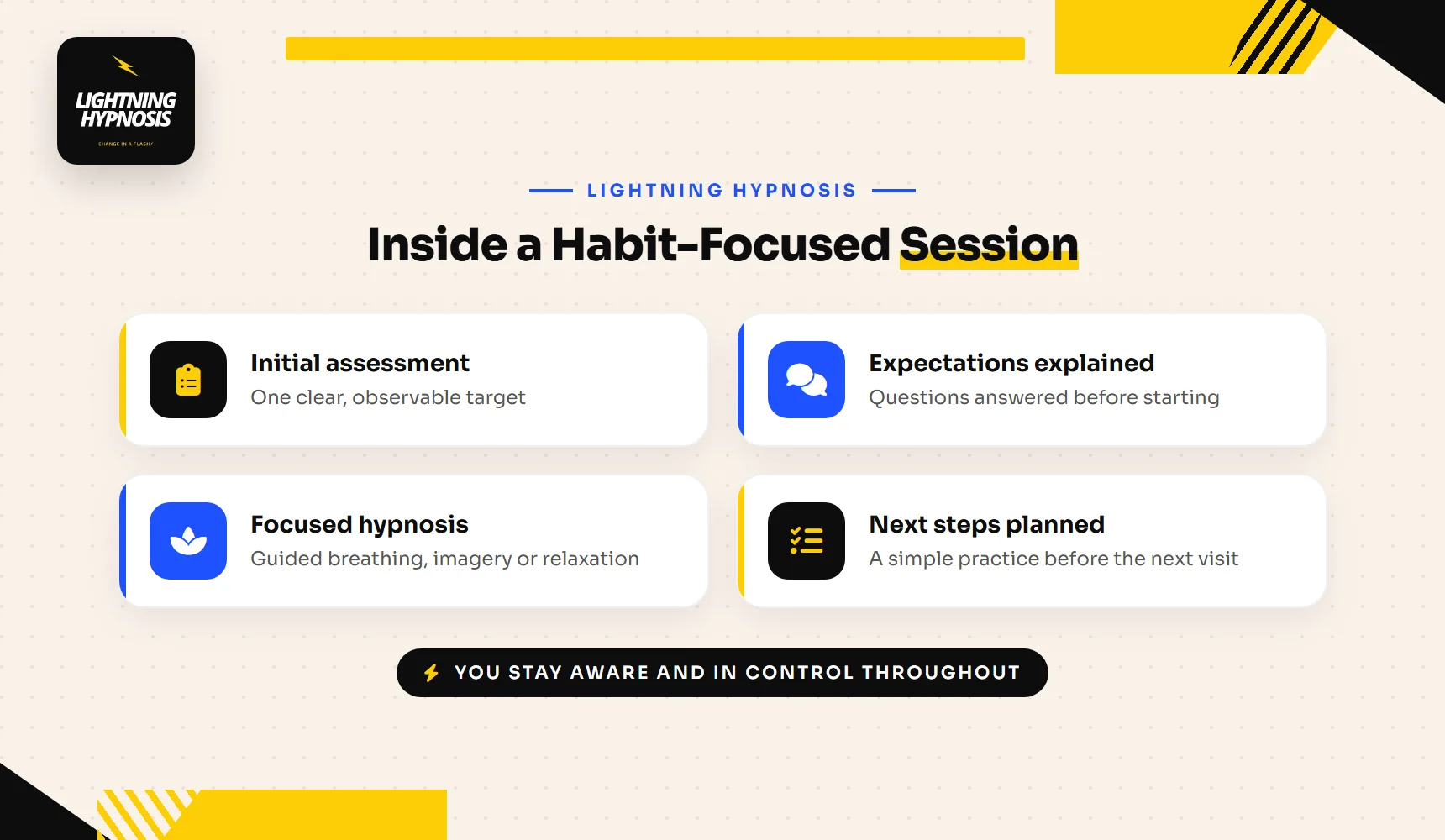
A habit-focused hypnotherapy session follows a structured process tailored to one clearly defined behavior. Although the exact approach varies between practitioners and clients, the appointment generally includes an assessment, an explanation of hypnosis, the focused portion of the session, and a closing discussion about practical next steps.
The Initial Habit Assessment
The practitioner begins by gathering information about the unwanted behavior, including when it started, how frequently it occurs, and how it affects the client’s daily life. Previous attempts to change the habit, relevant health conditions, medications, and current medical or mental health care may also be discussed.
The client and practitioner then agree on one observable treatment target. “Become more productive” is too broad, while “begin the first planned task after breakfast” provides a specific behavior that can be discussed and reviewed.
Expectations and Client Participation
Before hypnosis begins, the practitioner explains the proposed approach and gives the client an opportunity to ask questions. Any concerns about awareness, control, memory, or personal comfort should be addressed before proceeding.
The client remains an active participant throughout the appointment. Hypnotherapy depends on cooperation, so the client can request different wording, report discomfort, pause the process, or decide not to continue with a particular exercise.
Entering Hypnosis and Remaining Aware
The focused portion may begin with guided breathing, counting, imagery, progressive relaxation, or another attention-focusing method. The experience differs between individuals. Some people notice physical relaxation, while others mainly experience greater concentration on the practitioner’s words.
The client remains aware of the room and can usually hear, speak, move, or adjust position when needed. The practitioner follows the previously agreed session plan while monitoring the client’s comfort and level of engagement.
Closing the Session and Planning Next Steps
At the end of the focused portion, the practitioner gradually redirects the client’s attention to the immediate surroundings and checks that the person feels comfortable and alert. The client can then discuss what they noticed, ask questions, and clarify anything that felt unclear.
Before the appointment ends, the practitioner and client may agree on a simple observation or activity to complete before the next visit. Any follow-up plan should be realistic, clearly defined, and appropriate to the behavior being addressed.
Recognizing the trigger is often the first step toward interrupting an automatic habit. Lightning Hypnosis provides habit control hypnotherapy across El Paso and surrounding communities in West Texas and Southern New Mexico, helping clients identify habit cues, rehearse healthier replacement responses, and reinforce intentional behavior.
Frequently Asked Questions
Can hypnotherapy work if someone is skeptical about hypnosis?
Skepticism does not automatically prevent hypnosis. A person does not need unquestioning belief, but they must be willing to follow instructions, focus attention, and test the suggested response. Hypnotic responsiveness varies between individuals, so engagement and realistic expectations matter more than pretending to feel convinced beforehand.
How many hypnotherapy sessions are needed to change a habit?
There is no reliable fixed number because habits differ in duration, frequency, triggers, and function. A simple situational behavior may change sooner than a pattern connected to chronic stress or several environments. Progress should determine the schedule, not a package promising permanent change within a predetermined number of appointments.
Can several unwanted habits be addressed during the same session?
Several habits can be related, but addressing all of them simultaneously may make suggestions too broad. It is usually clearer to begin with one well-defined behavior and its strongest trigger. Once that response becomes easier to interrupt, the same process can be adapted to another habit without confusing the treatment target.
What if the person cannot identify what triggers the habit?
The trigger may initially be difficult to recognize because the behavior happens automatically. Recording the time, setting, emotions, physical sensations, and preceding activity can reveal repeated conditions. Hypnotherapy can then focus on recognizing the earliest detectable cue rather than requiring the person to uncover one hidden cause.
Can hypnotherapy be combined with counseling or medical treatment?
Yes. Hypnotherapy can be used alongside counseling, medical care, medication, or other behavior-change support when the professionals involved consider it appropriate. Clients should disclose relevant treatments and avoid changing prescribed care without consulting the qualified clinician responsible for managing it.