

What Is Imposter Syndrome and Why Do High Achievers Experience It?
Imposter syndrome is the persistent feeling that your success is not fully deserved, even when your performance, qualifications, and results show otherwise. High achievers can experience it because greater success often brings higher expectations, tougher comparison groups, and more pressure to repeat strong performance. This blog explains what these feelings mean, why they can persist among accomplished people, and how to respond to them constructively.
A Quick Answer
Imposter syndrome is a recurring pattern of doubting your competence or feeling undeserving of success despite objective evidence that you are capable. High achievers may experience it when increased expectations, perfectionistic standards, demanding comparison groups, and pressure to maintain performance make achievements harder to internalize.
Unlike ordinary self-doubt, imposter feelings can persist even after repeated success. Recognizing actual performance evidence, setting realistic standards, and examining how you attribute success can help create a more balanced view of your abilities.
What Does Imposter Syndrome Actually Feel Like?
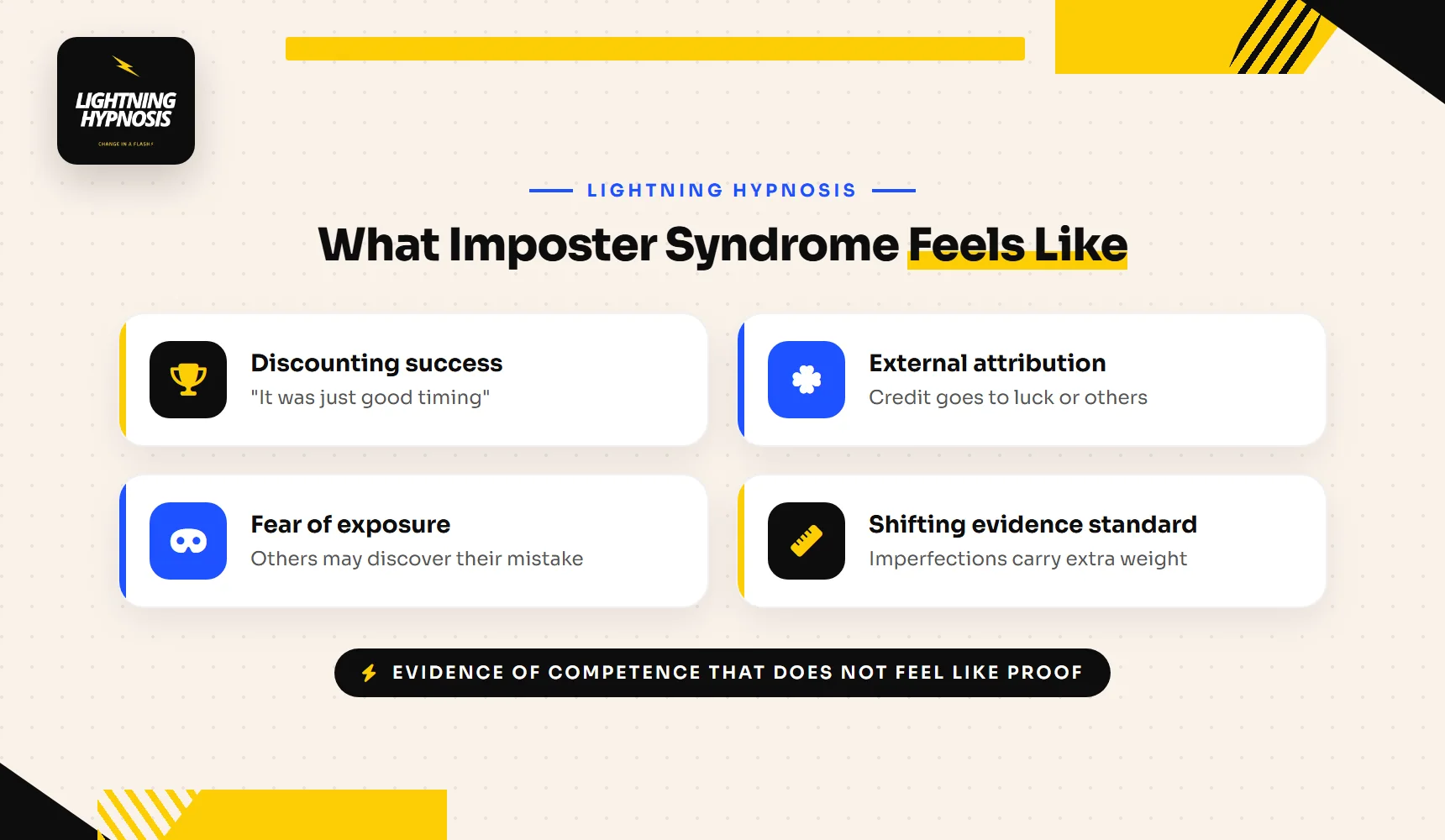
Imposter syndrome often appears as a mismatch between objective evidence of competence and a person’s interpretation of that evidence. The defining pattern is not simply feeling nervous or uncertain. It is repeatedly struggling to accept accomplishments as valid proof of your own capability.
Discounting Your Success
Someone experiencing imposter feelings may acknowledge that an achievement happened while minimizing what it says about their ability. A promotion becomes “just good timing,” a strong presentation becomes “nothing special,” or positive feedback is dismissed because the task supposedly was not difficult enough.
This creates a distorted evidence standard. Success must meet increasingly demanding conditions before it feels legitimate, while imperfections can carry disproportionate weight. As a result, qualifications, completed work, recognition, and consistently strong performance may fail to update how the person evaluates their competence.
Attributing Success to External Factors
Another common pattern is explaining positive outcomes primarily through factors outside personal ability. Success may be credited to luck, favorable circumstances, help from colleagues, an easy assignment, or unusually extensive preparation.
External factors can genuinely contribute to any achievement. The problem arises when they become the default explanation for success, leaving skill, judgment, knowledge, and effort consistently undervalued. The person accepts the result but discounts their own contribution to producing it.
Fear of Being Exposed
Imposter feelings can also involve concern that other people have overestimated your competence and may eventually discover their mistake. A new assignment, evaluation, presentation, or increased responsibility can therefore feel like a test of whether you truly belong.
This perceived risk of exposure can persist even without evidence of deception or inadequate performance. The fear centers on a gap between how capable others appear to believe you are and how capable you believe yourself to be, making future evaluation feel unusually consequential.
The Imposter Cycle: Why Success Does Not Always Build Confidence
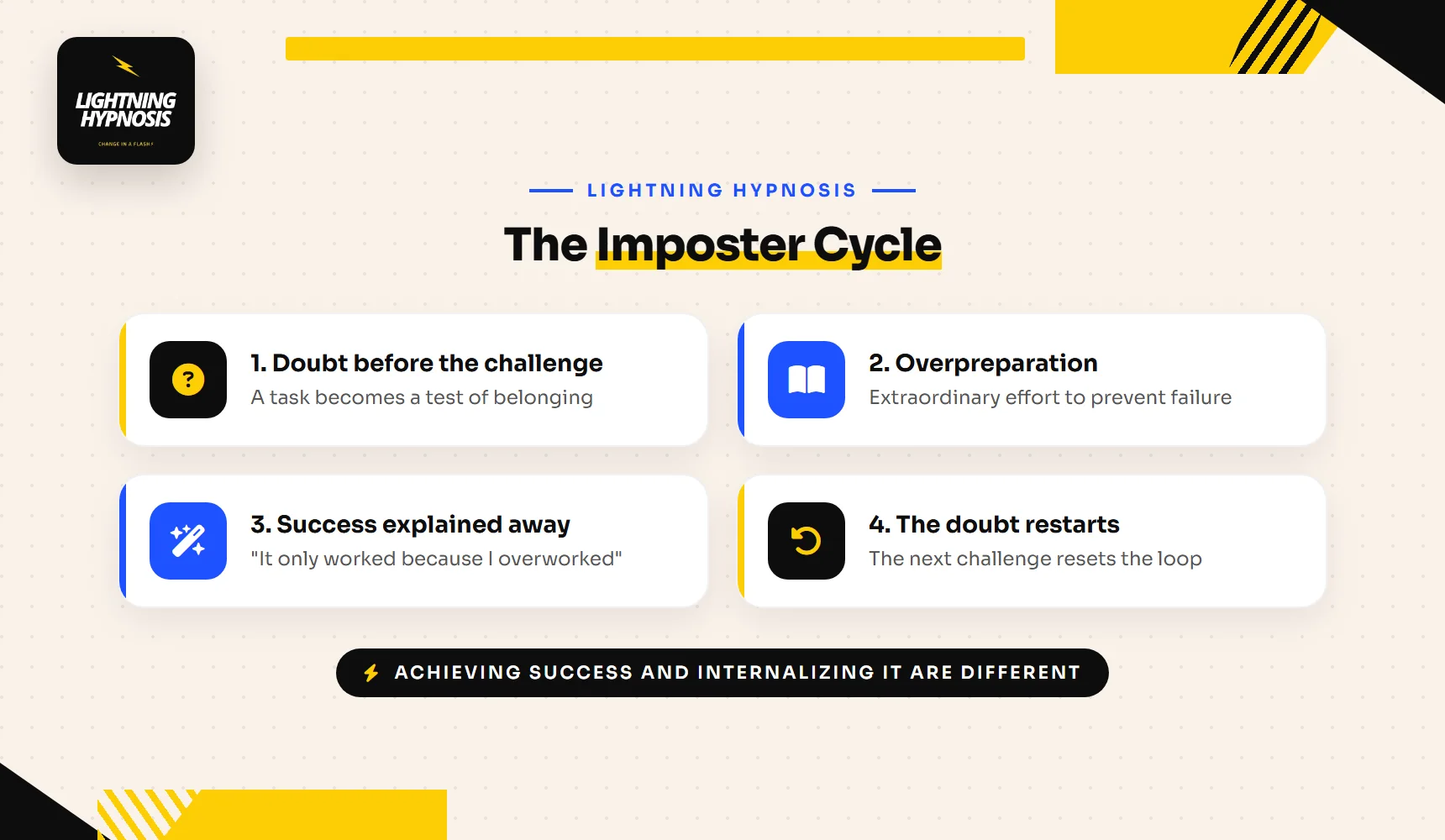
The imposter cycle explains how self-doubt can survive repeated evidence of strong performance. The key mechanism is how a person processes a demanding task before and after completing it, preventing the outcome from producing a lasting change in self-assessment.
Doubt Before the Challenge
The cycle can begin when a difficult assignment, exam, presentation, or professional responsibility creates uncertainty about performance. Rather than viewing the challenge as a test of specific skills, the person may treat it as a broader test of whether they deserve their position or reputation.
This raises the psychological cost of failure. The task is no longer only about producing a good result. It becomes evidence that could seemingly confirm or challenge the person’s underlying view of their competence.
Overpreparation or Performance Pressure
That perceived threat can trigger intense preparation and heightened monitoring of performance. Preparation itself is productive, but within the imposter cycle it may be driven by the belief that extraordinary effort is necessary to prevent failure.
When the outcome is successful, this creates a paradox. Instead of concluding, “I handled a difficult task effectively,” the person may conclude that success occurred only because they worked excessively hard. The coping strategy that supported performance then becomes a reason to discount capability.
Success Gets Explained Away
Once an achievement is attributed mainly to extraordinary effort, favorable circumstances, or another temporary factor, it provides little lasting evidence for future self-evaluation.
This distinction matters because achieving success and internalizing success are not the same process. A person can accumulate strong results without substantially changing their self-perception when each result is treated as an exception rather than evidence of an established capability.
The Next Challenge Restarts the Doubt
When another demanding situation appears, previous accomplishments may offer limited reassurance because they were never integrated into the person’s assessment of their abilities. Uncertainty returns, followed by renewed pressure to prove competence.
The cycle can therefore continue even as a person becomes more accomplished. Breaking the pattern requires changing how performance evidence is interpreted, not simply accumulating more achievements.
Imposter Syndrome vs. Normal Self-Doubt: What Is the Difference?
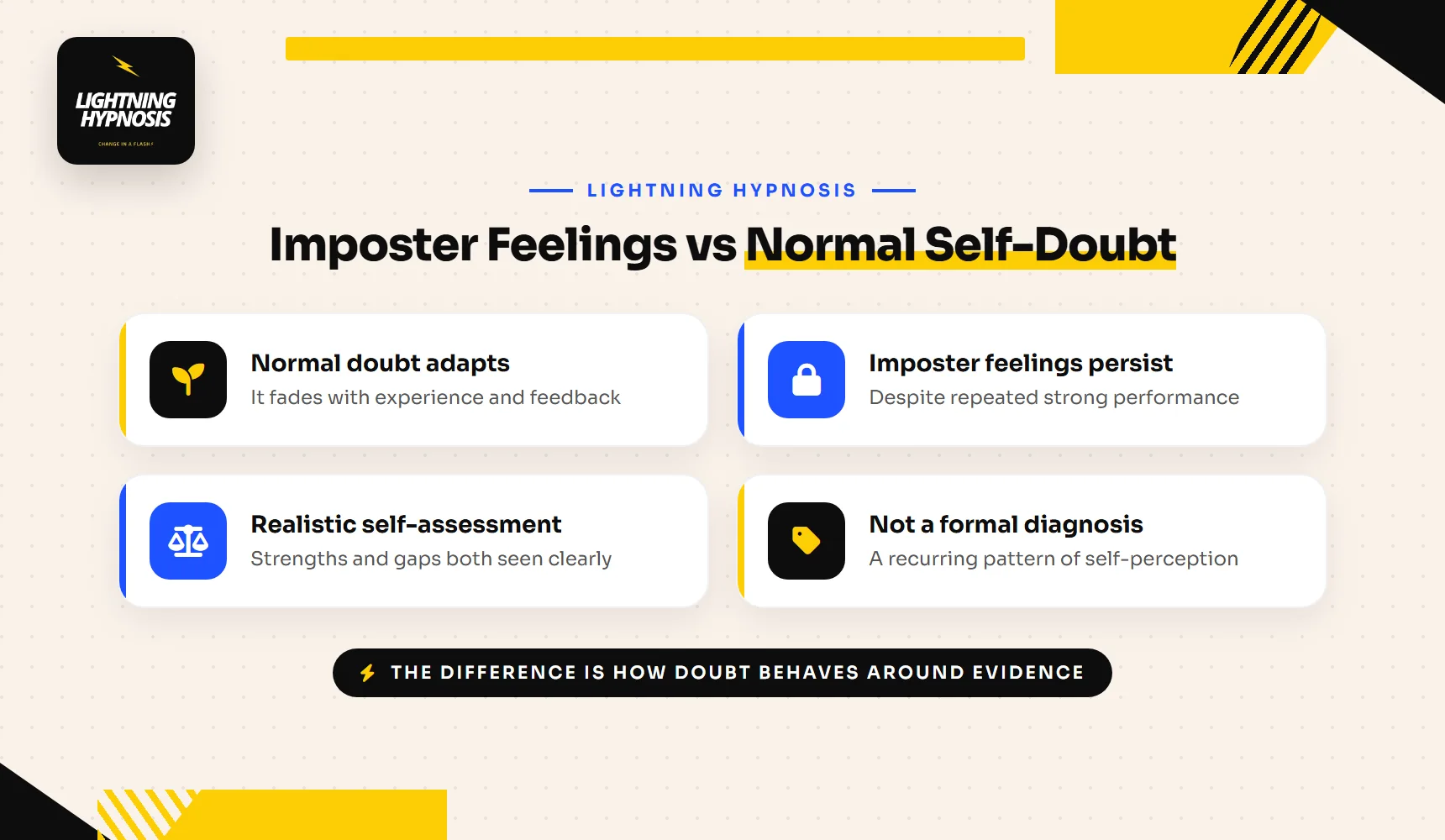
Normal self-doubt usually responds to new information. Imposter feelings are more persistent because evidence of competence does not reliably correct the person’s self-assessment. The distinction is therefore less about whether doubt exists and more about how that doubt behaves when performance evidence becomes available.
| Normal self-doubt | Imposter feelings |
|---|---|
| Often appears when facing an unfamiliar task or skill | Can continue despite repeated evidence of strong performance |
| Usually decreases as experience, knowledge, or feedback improves | Positive feedback may be discounted or treated as unrepresentative |
| Allows both strengths and weaknesses to be assessed realistically | Competence may be underestimated even when objective results are strong |
| Is usually tied to a specific situation | Can recur across promotions, evaluations, academic settings, or other achievement contexts |
| Does not necessarily involve concerns about legitimacy | May include a sense of being less capable than others believe |
This distinction also prevents overusing the term. Feeling uncertain before a presentation, questioning a difficult decision, or recognizing that you still have skills to develop does not automatically indicate imposter syndrome. Realistic self-evaluation can include doubt without producing a persistent sense that success is undeserved.
Imposter syndrome is also not a formal psychiatric diagnosis. Researchers more often use terms such as impostor phenomenon or impostor feelings, and prevalence estimates vary because studies use different populations, definitions, and measurement tools.
For that reason, it is more accurate to describe a recurring pattern of self-perception than to treat imposter syndrome as a discrete mental disorder.
What Can High Achievers Do About Imposter Feelings?
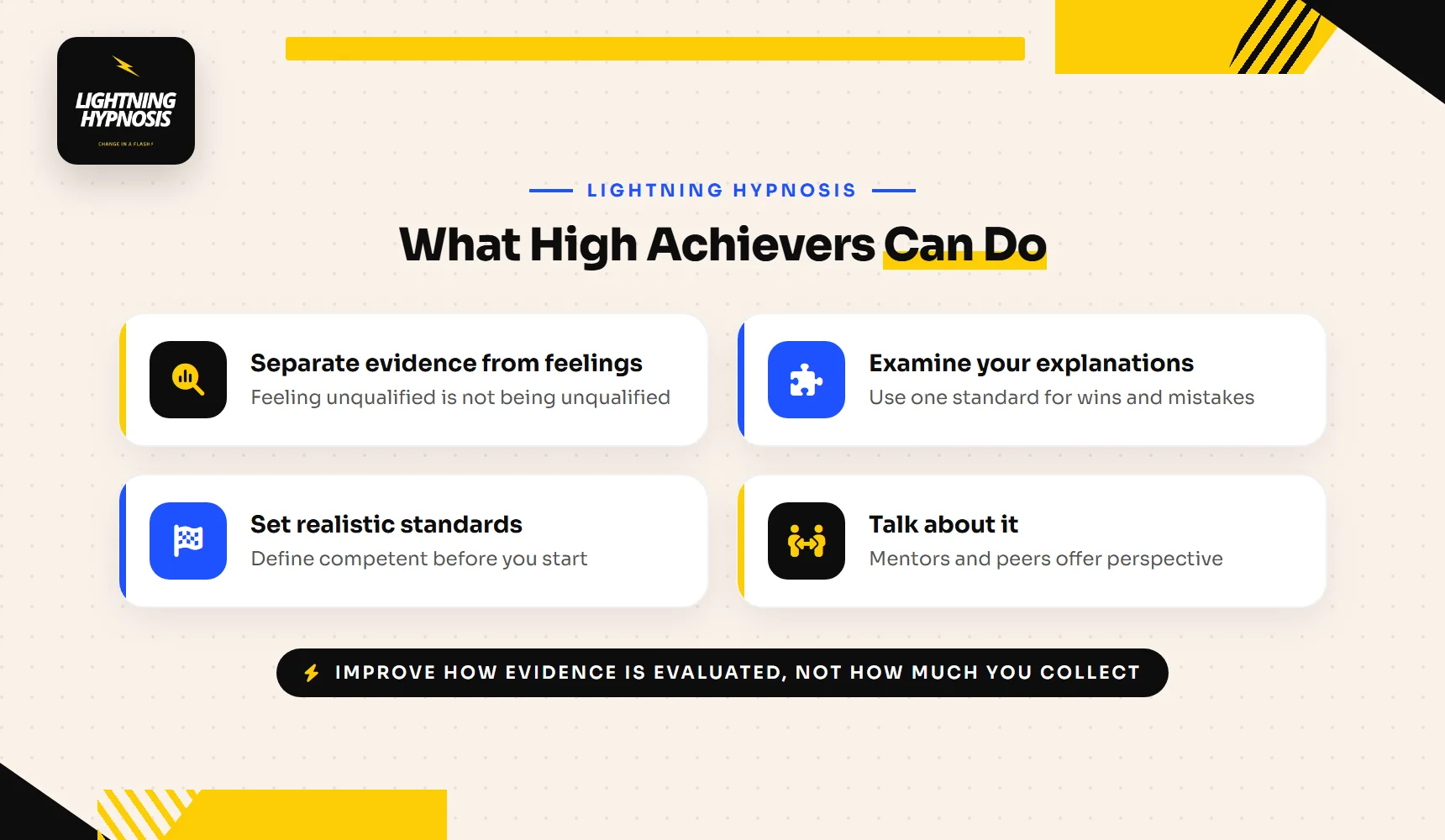
Managing imposter feelings requires more than accumulating additional achievements. A more useful approach is to improve how competence, mistakes, expectations, and performance evidence are evaluated so that self-assessment becomes more accurate.
Separate Evidence From Feelings
Feeling unqualified and being unqualified are different conclusions. When self-doubt appears, compare the feeling with observable evidence such as completed projects, qualifications, measurable results, responsibilities earned, and specific feedback.
The goal is not forced positive thinking. It is evidence-based self-assessment. A difficult task can create uncertainty without invalidating the skills that earned you the opportunity to handle it.
Examine How You Explain Success
Pay attention to whether you apply different standards to positive and negative outcomes. For example, consistently crediting success to circumstances while treating every mistake as evidence of personal inadequacy creates an unbalanced picture of performance.
Use a more complete attribution: identify the skills, decisions, preparation, collaboration, and external circumstances that contributed to the result. This produces a more realistic account of both success and failure.
Replace Perfection With Realistic Standards
High standards become counterproductive when anything short of flawless performance is interpreted as inadequate. Define what competent performance actually requires before starting a task, including acceptable limitations and reasonable room for error.
Evaluate the finished work against those requirements rather than an idealized version of what could have been achieved. This preserves ambition without making perfection the threshold for legitimacy.
Talk About the Experience
Discussing persistent imposter feelings with a trusted mentor, colleague, or peer can provide an external reference point for evaluating assumptions about competence and expectations. It can also reveal that uncertainty exists among capable people without indicating professional or academic inadequacy.
If these feelings become persistent enough to cause significant distress or interfere with work, study, relationships, or daily functioning, speaking with a qualified mental health professional can provide more individualized support.
Can Hypnotherapy Help With Imposter Syndrome?
Hypnotherapy may be used to explore and work with underlying beliefs that contribute to persistent self-doubt, such as feeling inadequate, fearing failure, or believing success must be earned through perfection. Rather than treating imposter syndrome as a medical condition, hypnotherapy can focus on the thought patterns and emotional responses associated with these experiences.
For people whose imposter feelings are connected with deeply established beliefs about competence or self-worth, hypnotherapy may complement broader strategies for developing a more balanced self-perception. Results vary between individuals, and it should not replace appropriate mental health care when anxiety, depression, or significant distress is present.
Success should not always feel like something you have to prove. Lightning Hypnosis offers imposter syndrome hypnotherapy for clients across El Paso and the surrounding Texas–New Mexico region, helping you work with the underlying beliefs and thought patterns that may reinforce self-doubt. Take the next step toward approaching your achievements with greater confidence and perspective. Contact us today to get started.
Frequently Asked Questions
What are the three C's of imposter syndrome?
The “three C’s” is not a standardized psychological model of the impostor phenomenon. Different coaching and workplace sources use the label for different concepts, so there is no universally accepted set of three C’s in clinical research. For accuracy, focus instead on recognized patterns such as difficulty internalizing success, perceived fraudulence, and attributing accomplishments to external factors.
What type of person gets imposter syndrome?
Imposter feelings are not limited to one personality type or level of success. They have been reported among students, professionals, leaders, and other accomplished groups. Factors associated with stronger impostor feelings can include perfectionistic concerns, fear of evaluation, demanding performance environments, and difficulty integrating positive performance evidence into one's self-assessment.
What are the five types of imposter syndrome?
A popular framework developed by Valerie Young describes five types: the Perfectionist, Expert, Soloist, Natural Genius, and Superhuman. These categories can provide a practical way to recognize different achievement-related thought patterns, but they should not be treated as five clinically validated subtypes or diagnostic categories of the impostor phenomenon.
What are the root causes of imposter syndrome?
Research does not identify one universal root cause. Imposter feelings appear to involve multiple psychological and contextual factors, with studies finding associations involving perfectionistic concerns, self-esteem, attribution patterns, family and social experiences, and demanding academic or professional environments. The combination and relative importance of these factors can differ substantially between individuals.
What is the best therapy for imposter syndrome?
There is no single therapy officially designated as the best treatment because imposter syndrome is not a formal psychiatric diagnosis. When persistent impostor feelings occur alongside anxiety, depression, perfectionism, or significant distress, a mental health professional can assess the underlying difficulties. Cognitive behavioral approaches may be used to address unhelpful beliefs and patterns relevant to those concerns.
What should you say to someone with imposter syndrome?
Avoid simply telling them they are talented or that their concerns are irrational. Ask what evidence is driving their conclusion, acknowledge the difficulty they are experiencing, and point to specific examples of demonstrated competence rather than offering vague reassurance. Encouraging a balanced assessment of both strengths and limitations can be more constructive than dismissing their uncertainty.
Is imposter syndrome a form of anxiety?
Imposter syndrome is not classified as an anxiety disorder, although impostor feelings can occur alongside anxiety and may involve worry about evaluation, mistakes, or being exposed as inadequate. The concepts should not be treated as interchangeable. Persistent or severe anxiety that interferes with daily functioning warrants assessment on its own rather than being assumed to be imposter syndrome.