
Signs Stress Is Turning Into Burnout
Stress is loud. Burnout is quiet, and that is why people miss the moment one becomes the other.
Under stress, you feel pressure, urgency, and too much to do. You are still engaged, still trying, still reacting. Burnout arrives after the pressure has run long enough without recovery that the reacting stops. The urgency flattens into indifference. Work that mattered stops mattering. Most people read that flatness as laziness or a bad patch rather than as a signal.
This guide covers what separates the two, the early signs that get explained away, the three dimensions that define burnout in the research, and the point at which what you are describing needs a doctor rather than a coping strategy.
Key Takeaways
Stress is over-engagement. Burnout is disengagement. Under stress, you care too much with too little capacity. In burnout, the caring itself has gone quiet.
The earliest reliable signal is that rest stops working. A weekend or a holiday that leaves you no better than before is a recovery failure, not a rest shortage.
The three dimensions are exhaustion, cynicism toward the job, and a reduced sense of effectiveness. Together and sustained over months, they describe burnout. Individually, they describe a bad stretch.
Persistent exhaustion warrants a doctor before anything else. Thyroid problems, anemia, sleep apnoea, and several deficiencies produce the same symptoms and are identified by ordinary blood work.
Stress and Burnout Are Not the Same Thing
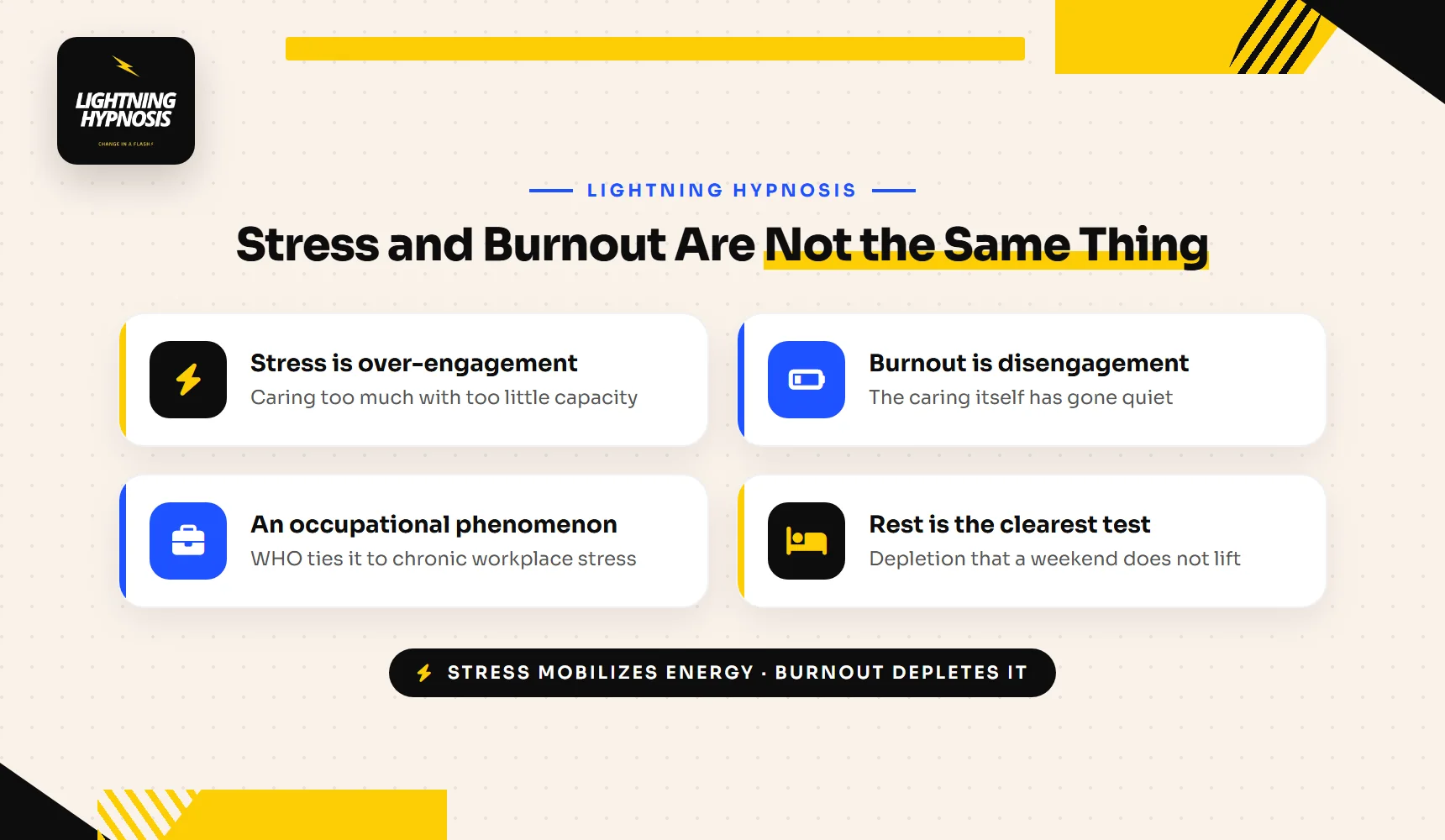
Stress is over-engagement. Burnout is disengagement. Under stress, you care too much and have too little capacity. In burnout, the caring itself has gone quiet.
The distinction sits in what happens to your energy. Stress mobilizes it, which is why stressed people are visibly busy, reactive, and often productive right up until they are not. Burnout depletes it, and the depletion does not lift with a weekend, a good night's sleep, or a week away.
The World Health Organization defines burnout as a syndrome resulting from chronic workplace stress that has not been successfully managed, and classifies it as an occupational phenomenon rather than a medical condition.
WHO also draws a boundary most articles ignore: burnout refers specifically to the occupational context and should not be used to describe exhaustion in other areas of life. Caring for a parent, raising small children, or grieving can leave you profoundly depleted, but that is not what burnout describes, and the distinction matters because the responses are different.
It is also not classified as a medical condition. WHO places it among factors that bring people into contact with health services rather than among illnesses. That does not make it minor. It means burnout is understood as something a set of conditions does to a person over time, not something wrong with the person.
The practical consequence is that burnout does not announce itself. Stress has a clear cause you can point at. Burnout accumulates quietly, and the clearest early evidence is not how hard things feel but whether rest still works.
The Early Signs People Explain Away
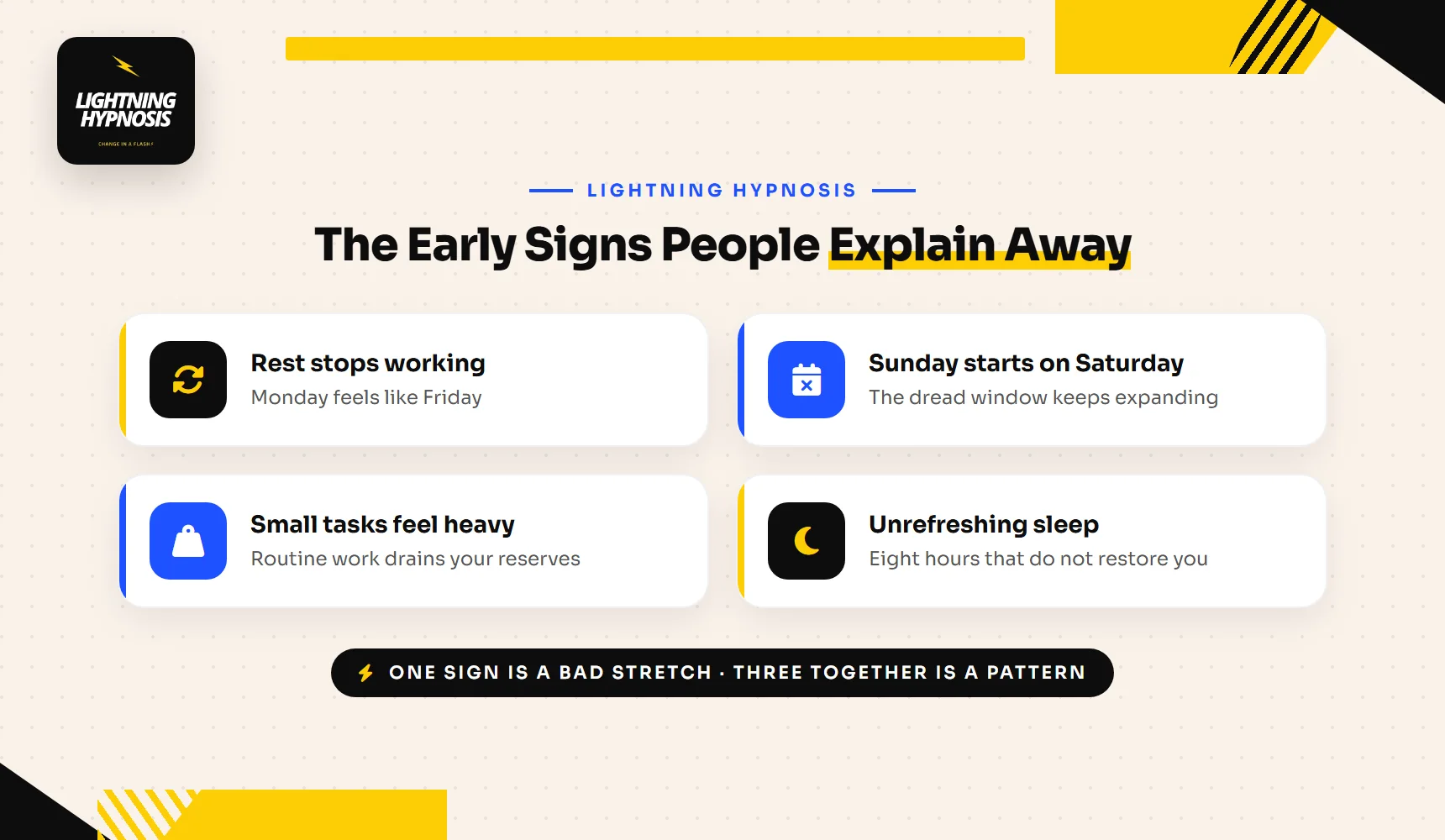
The most useful signals appear months before anyone uses the word burnout. They get attributed to a busy season, poor sleep, or getting older.
Rest Stops Working
The single most reliable early signal is that recovery stops recovering you.
A normal weekend should return some capacity. Two days off produce a noticeable difference on Monday morning. When that stops happening, when you wake on Monday feeling roughly as depleted as you did on Friday, the recovery mechanism itself is failing rather than the rest being insufficient.
The same thing shows up on holiday. The first few days feel like relief, the middle stretch feels genuinely better, and then within a day or two of returning the entire benefit disappears. People usually read that as evidence they need a longer holiday. It is closer to evidence that the load is exceeding what any amount of time off can offset.
Sleep follows the same pattern. Eight hours that leave you unrefreshed is not a sleep quantity problem, and it is one of the earliest things worth mentioning to a doctor, since several medical conditions produce exactly that.
Sunday Starts on Saturday
Anticipatory dread is a timing signal, and the timing tells you more than the feeling does.
Most working people feel something on Sunday evening. That is ordinary. What matters is whether that window is expanding. When the dread arrives on Sunday afternoon, then Sunday morning, then somewhere in Saturday, the recovery period is shrinking from both ends and the actual time off has become a fraction of the calendar time off.
This tends to be one of the last things people mention, because it feels like a complaint rather than a symptom. It is worth tracking honestly. If your genuine break has narrowed to a few hours on Saturday, you are not getting two days of recovery regardless of what the schedule says.
Small Tasks Feel Disproportionate
Effort inflation is subtle and specific: the same tasks you have always done start requiring visibly more from you.
Sending a routine email takes three attempts to start. A meeting you would once have walked into unprepared now needs bracing for. A decision you would have made in a minute sits open for two days. Nothing has changed about the work, only what it costs to do it.
People almost always explain this as a discipline failure, and the self-criticism that follows becomes part of the load. It is more usefully read as a capacity signal. When routine demands start drawing on reserves rather than running on ordinary energy, the reserves are already low.
The pattern to watch for is all three of these appearing together over a period of months. Any one in isolation is a bad stretch. Together and sustained, they describe something that is not resolving on its own.
The Three Dimensions of Burnout
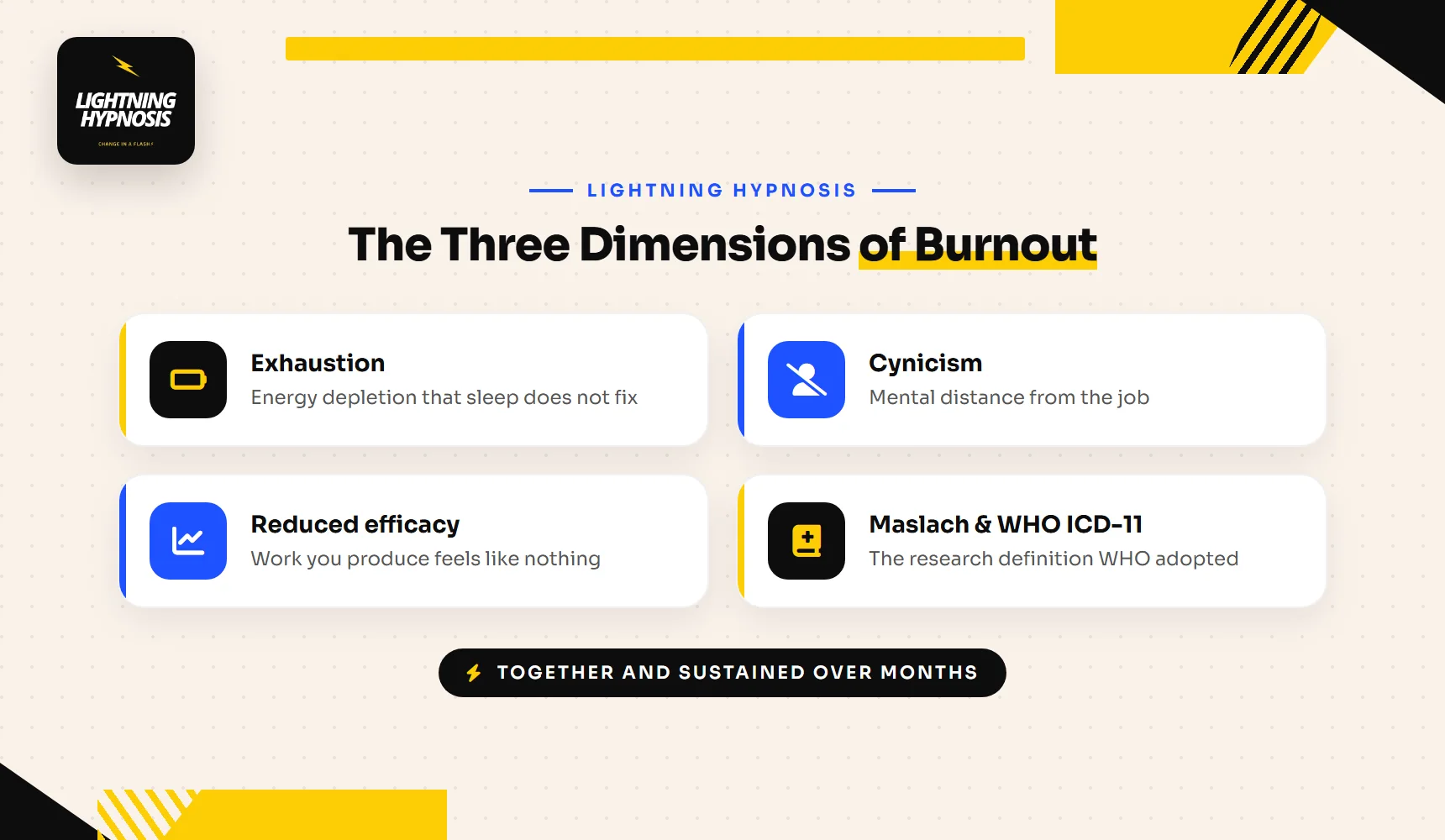
Burnout research has converged on three dimensions since Christina Maslach began measuring it in the 1970s, and WHO adopted the same three in its ICD-11 description. They tend to appear in sequence rather than all at once.
Christina Maslach began measuring burnout in the 1970s, and the National Academies records her framework of exhaustion, cynicism, and reduced efficacy as the agreed definition in the research literature, which WHO subsequently adopted.
Exhaustion That Sleep Does Not Fix
This is the dimension people recognize, and it is broader than tiredness. WHO describes it as feelings of energy depletion or exhaustion.
The distinguishing feature is that it is not proportional to activity. Ordinary tiredness follows effort and resolves with rest. This does not. It is present on waking, persists through days off, and is often described as feeling hollowed out rather than sleepy. Some people describe being simultaneously exhausted and unable to switch off, which is what happens when the body stays in a state of alert while running on depleted reserves.
It usually shows up physically before anyone connects it to work: shoulder and jaw tension, headaches, disrupted appetite, catching every circulating illness. Those signals are also the ones that most warrant a medical opinion, which the next section covers.
Cynicism and Emotional Distance
The second dimension is the one that surprises people, because it does not feel like a symptom. It feels like a change in personality.
WHO describes it as increased mental distance from one's job, or feelings of negativism or cynicism related to it. In practice, it presents as detachment. Colleagues become irritating rather than familiar. Requests that once seemed reasonable start seeming unreasonable. Work you were invested in becomes something to get through.
For anyone in caregiving, healthcare, teaching, or service work, this dimension carries an additional weight, since emotional distance from the people you serve conflicts directly with why most people entered those fields. The distance is not indifference. It is what depletion does when there is nothing left to give, and it commonly arrives alongside guilt about feeling it at all.
Occupational context shapes who this reaches in El Paso, TX. The region's largest employers concentrate in healthcare, public education, government service, and the military community around Fort Bliss, which means a substantial share of the local workforce sits in exactly the fields where this dimension lands hardest. A nurse, a teacher, or a service member who finds themselves detached from the people they are responsible for is describing a symptom rather than a character change, though it rarely feels that way from the inside.
The signal is direction of travel. Cynicism about a specific bad decision is normal. Cynicism that has generalized to everything and everyone, in someone who was not previously cynical, is the dimension showing itself.
Reduced Sense of Accomplishment
The third dimension is reduced professional efficacy, and it is the most self-reinforcing.
You produce work, and it feels like nothing. Achievements register faintly or not at all. Competence you have demonstrated for years starts feeling like something you are faking, and you begin to doubt whether you were ever good at this.
The loop closes because the response is almost always to work harder. Feeling ineffective produces more hours, more effort, and less recovery, which deepens the exhaustion that is causing the ineffectiveness. People frequently arrive at this stage having quietly increased their workload for months in an attempt to fix a problem that more work makes worse.
When present together and sustained over months, these three dimensions describe burnout. Present in an occupational context specifically, since that is the boundary WHO draws around the term.
Physical Signs That Deserve a Doctor, Not a Coping Strategy
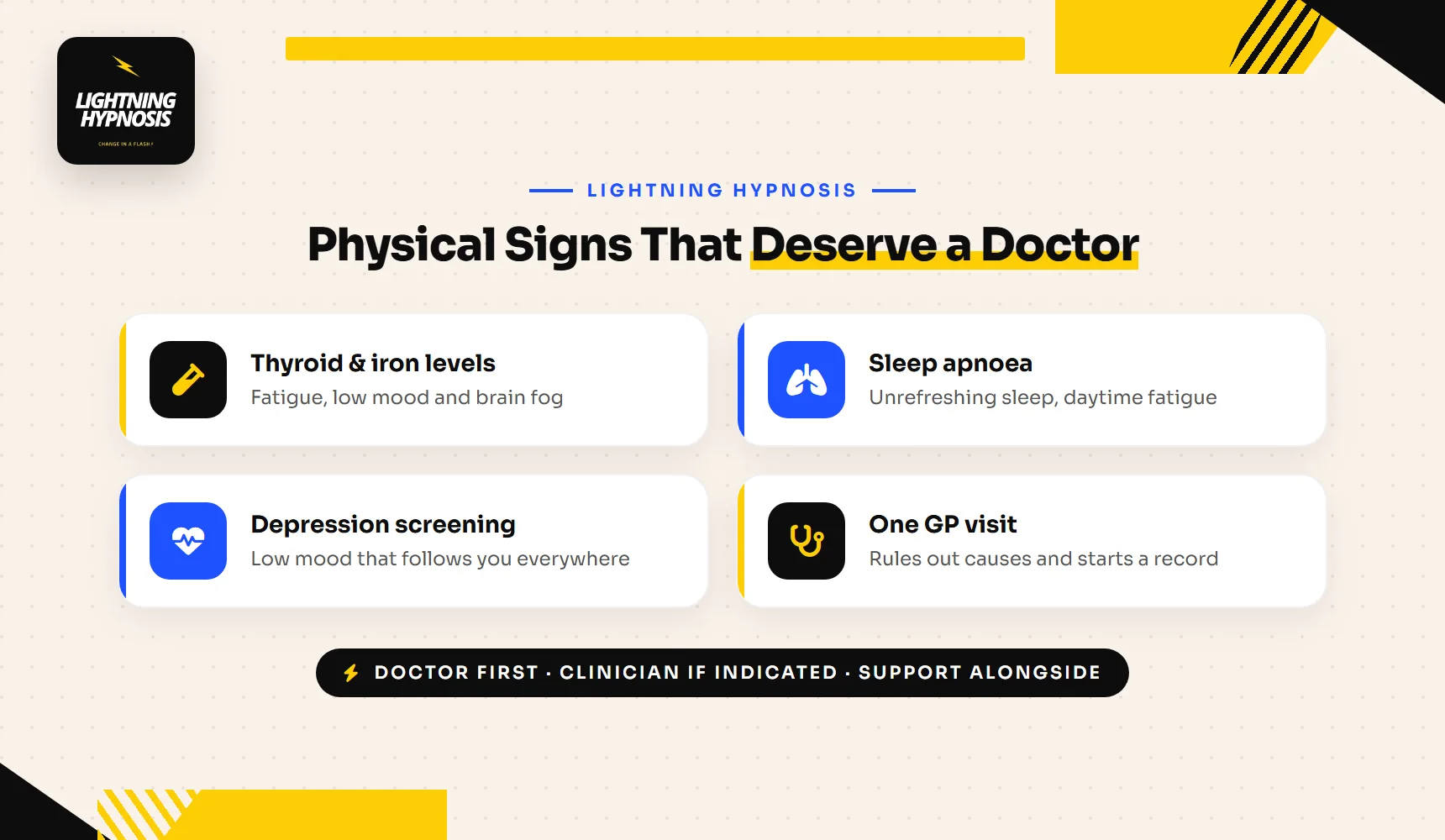
Burnout and several treatable conditions share the same symptoms. This section is the most important one in the article, because the wrong assumption here delays care that would help.
Symptoms That Overlap With Medical Conditions
Persistent exhaustion is a common presenting symptom in general practice, and burnout is one of many possible explanations.
Thyroid dysfunction produces fatigue, low mood, and cognitive fog. Iron deficiency and anemia produce exhaustion and breathlessness that no amount of rest resolves. Sleep apnoea produces unrefreshing sleep, daytime fatigue, and irritability in people who believe they are sleeping normally. Vitamin D and B12 deficiency, diabetes, and several autoimmune conditions all present similarly, and all are identified by ordinary blood work.
Attributing months of unexplained exhaustion to your job without testing is a reasonable-sounding assumption that turns out wrong often enough to matter. If exhaustion has persisted for more than a few weeks, a doctor comes before any other intervention.
When It May Be Depression Rather Than Burnout
Burnout and depression overlap substantially, and telling them apart is a clinical judgment rather than a self-assessment.
The rough distinction researchers draw is scope. Burnout is bounded by the occupational context, which is why WHO says the term should not be applied to other areas of life. Someone burned out on work often still enjoys weekends, friendships, and interests. Depression is not domain-specific. It follows you into the things you used to like, and the flatness applies everywhere.
That distinction is useful for orientation and unreliable for diagnosis, because prolonged burnout can develop into depression and many people have both. Any of the following warrants a doctor rather than further self-analysis: persistent low mood most of the day for two weeks or more, loss of interest in things that previously mattered outside work, significant changes in appetite or weight, or hopelessness about the future.
If you have thoughts of harming yourself, that is not something to work through on your own. In the US, the 988 Suicide and Crisis Lifeline is available by call or text, 24 hours a day.
What a GP Visit Rules Out
A first appointment for persistent exhaustion is usually straightforward. Expect questions about sleep, mood, appetite, and workload, and expect blood work covering thyroid function, iron, vitamin D, B12, and blood glucose.
That single visit does two things. It rules out the medical explanations, which is worth knowing either way. And it establishes a record, which matters if you later need adjustments at work or a period of leave.
Go with specifics rather than a summary. How long it has been happening, whether rest changes anything, what has shifted in your sleep, and what your working hours actually look like. Duration and the failure of rest to help are the two details that most shape what a doctor does next.
What Actually Helps and What Does Not
Recognition is the useful part of this article. What follows it is more limited than most content on this topic admits.
Why a Holiday Rarely Resolves It
Time off is not a treatment for burnout, and the reason sits in the WHO definition itself: burnout results from chronic workplace stress that has not been successfully managed. A holiday pauses the stress. It does not change how it is managed.
The predictable pattern is relief for a few days, genuine improvement in the middle, and the benefit disappearing within a week of returning. That is not a sign the holiday was too short. It is a sign that the conditions producing the depletion are unchanged and waiting.
Rest is still worth taking. It is just worth understanding it as relief rather than resolution, so a failed holiday is not read as personal failure.
Where Support Fits Alongside Medical Care
Medical assessment comes first. Once conditions like thyroid dysfunction, anemia, and sleep disorders have been ruled out, and depression has been assessed by a clinician, other forms of support have a clearer role.
Licensed therapy and counseling are the appropriate route for depression, anxiety, or trauma, and a doctor can refer you.
Complementary approaches, including stress and burnout hypnotherapy in El Paso, TX, work at a narrower level: the stress response itself, sleep patterns, and the habitual reactions that keep the nervous system on alert. That can be genuinely useful for someone managing a high-pressure period, and it is not a substitute for medical or mental health care. Anyone offering it as one is overstating what it does.
The sequence that makes sense is doctor first, clinician if indicated, and supportive approaches alongside rather than instead of either.
Recognizing the pattern is the part that takes the longest. Lightning Hypnosis offers hypnotherapy across El Paso and the surrounding communities in West Texas and Southern New Mexico, working with stress responses, sleep patterns, and the habitual reactions that keep the body on alert. Sessions support emotional wellness alongside medical and mental health care rather than in place of it. Contact our team to arrange a free consultation.
Frequently Asked Questions
How long does burnout take to recover from?
Recovery timelines vary widely and depend more on whether the conditions change than on how long you rest. People who alter workload, control, or role often see improvement over weeks to months. People who rest without changing the underlying situation typically find the relief temporary, which is why time off alone rarely resolves it.
Can you be burned out if you like your job?
Yes. Burnout results from chronic workplace stress that has not been managed, not from disliking the work. People who care most about their work are often at higher risk, because they absorb more, set fewer limits, and keep going longer before the depletion registers.
Is burnout an official medical diagnosis?
No. WHO classifies burnout in ICD-11 as an occupational phenomenon rather than a medical condition, placing it among factors that bring people into contact with health services. That does not make it minor. It means it describes what sustained conditions do to a person rather than an illness within them.
Can burnout cause physical illness?
Chronic stress affects sleep, immune function, blood pressure, and digestion, and prolonged burnout commonly appears alongside those problems. Whether the burnout caused them or an untreated medical condition produced symptoms mistaken for burnout is not something to assume either way, which is why medical assessment comes first.
Should I tell my employer I am burned out?
That depends on your workplace and your situation. What tends to help is describing specifics rather than the label: what your workload actually is, what has changed, and what adjustment would make a difference. A GP record of the symptoms and their duration is useful before that conversation, particularly if leave or formal adjustments may follow.