

- Lightning Hypnosis
Why Do People Procrastinate Even When They Want to Succeed?
Key Takeaways:
|
Many people genuinely want to achieve meaningful goals, yet still postpone the very tasks that would move them forward. Research shows this behavior is rarely explained by laziness alone. Instead, procrastination often results from how the brain processes emotions, rewards, uncertainty, and perceived effort in the moment. Understanding these underlying mechanisms is the first step toward changing them. This article examines the science behind procrastination and explores evidence-based strategies that can help reduce it.
Procrastination Is Not Laziness: What Science Says Instead
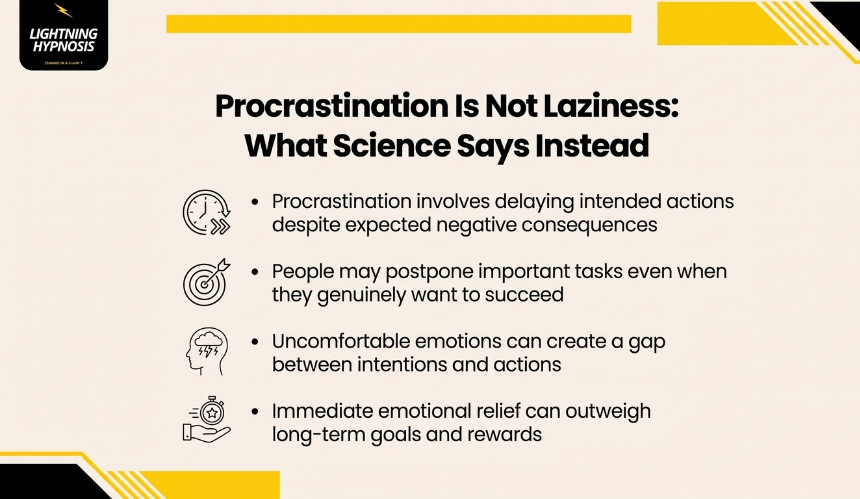
Many people interpret procrastination as a lack of discipline or work ethic. Psychological and neuroscience research paints a different picture. Procrastination is a pattern of voluntarily delaying an intended action despite expecting negative consequences, and it is more closely associated with emotional regulation than with a person’s willingness to work.
What Is the Difference Between Procrastination and Laziness?
Laziness generally reflects a lack of desire or motivation to engage in an activity. A person who is procrastinating, however, usually wants to complete the task and understands its importance but struggles to begin or continue working. The conflict lies between long-term intentions and short-term emotional comfort.
Researchers describe procrastination as an intention-action gap. The individual forms a clear goal but postpones taking action because the immediate emotional experience of the task feels unpleasant, overwhelming, or mentally demanding. This distinction explains why highly ambitious, capable, and successful people can also struggle with procrastination.
Why Do People Delay Tasks They Genuinely Care About?
People often delay meaningful work because the task carries emotional weight. Activities linked to career advancement, academic performance, financial decisions, or personal growth frequently involve uncertainty, evaluation, or the possibility of failure. The greater the perceived stakes, the stronger the urge to avoid the discomfort associated with starting.
The brain naturally prioritizes immediate emotional relief over distant rewards. Delaying a challenging task can temporarily reduce feelings such as anxiety, frustration, or self-doubt, even though the delay ultimately creates greater stress. As a result, people may postpone the very opportunities they value most.
How Do Emotions Drive Procrastination More Than Time Management?
Modern psychological research increasingly identifies procrastination as an emotional regulation challenge rather than a scheduling problem. Difficulty managing uncomfortable emotions can become a stronger predictor of procrastination than poor planning alone.
When a task triggers emotions such as anxiety, boredom, perfectionistic pressure, or uncertainty, the brain seeks a faster source of psychological relief. Choosing an easier activity, checking messages, or completing less demanding work provides an immediate sense of reward, making avoidance temporarily feel beneficial.
This emotional decision often occurs automatically, which explains why better calendars or longer to-do lists rarely solve chronic procrastination on their own.
Research Insight: In a 2022 randomized controlled trial involving 148 university students, researchers tested a nine-week online emotion regulation program against a wait-list control group. Students who completed the training showed a significant reduction in procrastination, and the analysis indicated that improved emotion regulation skills helped explain the change. The findings support the view that procrastination can result from difficulty managing unpleasant task-related emotions, rather than from laziness or poor scheduling alone. Because the participants were university students, the results should not automatically be generalized to every age group or form of procrastination. |
The Main Psychological Reasons People Procrastinate
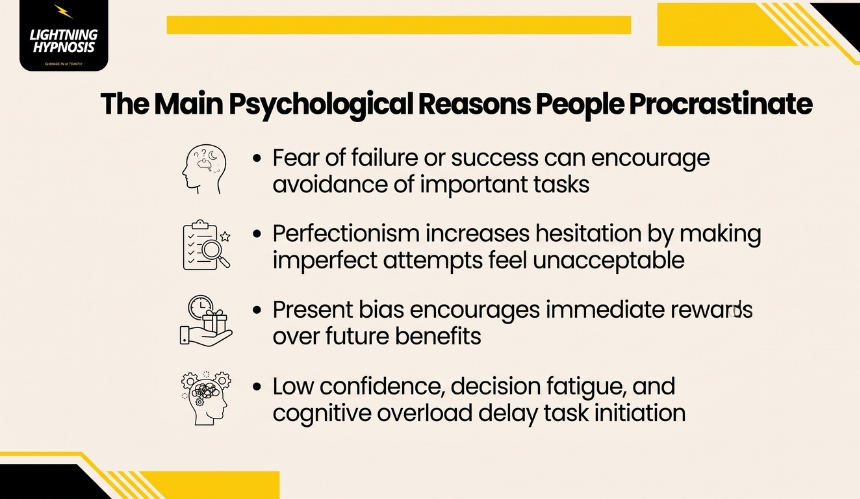
Procrastination rarely has a single cause. Instead, it emerges from the interaction of cognitive biases, emotional responses, and self-perceptions that influence how the brain evaluates effort, uncertainty, and reward. Understanding these mechanisms makes it easier to identify the real barrier to action rather than treating all procrastination as the same problem.
1. Fear of Failure and Fear of Success Lead to Procrastination
Fear of failure is one of the most extensively studied predictors of procrastination. When a task becomes closely tied to self-worth or external evaluation, delaying it can temporarily protect an individual from the possibility of making mistakes or receiving negative feedback. Although avoidance provides short-term emotional relief, it often increases pressure as deadlines approach.
Less commonly, some people also experience fear of success. They may associate achievement with greater responsibility, higher expectations, or significant life changes. In these cases, postponing action becomes a way to avoid the perceived consequences of succeeding rather than the work itself.
2. Perfectionism Increase the Risk of Procrastination
Perfectionism can make starting a task feel more difficult than completing it. Individuals who set unrealistically high standards often believe their work must be flawless from the outset. This mindset increases hesitation because any imperfect first attempt feels unacceptable.
Research distinguishes between healthy striving for excellence and maladaptive perfectionism. While healthy standards can encourage persistence, maladaptive perfectionism increases self-criticism, fear of mistakes, and avoidance behaviors that contribute to chronic procrastination.
3. Present Bias and the Brain's Reward System Influence Procrastination
The brain naturally gives greater value to immediate rewards than future benefits, a cognitive tendency known as present bias or temporal discounting. Because the rewards of studying, exercising, or completing a complex project often arrive weeks or months later, the brain may instead prioritize activities that provide instant gratification.
This preference is closely linked to the brain’s reward circuitry, particularly dopamine pathways involved in motivation and reinforcement. Highly stimulating activities such as social media, online entertainment, or checking notifications produce immediate rewards with relatively little effort, making them more appealing than cognitively demanding tasks with delayed outcomes.
4. Low Self-Efficacy, Decision Fatigue, and Cognitive Overload
Self-efficacy refers to a person’s belief in their ability to complete a task successfully. When confidence is low, even manageable tasks can appear more difficult than they actually are, increasing hesitation and delaying action.
Decision fatigue also plays a role. After making numerous decisions throughout the day, mental resources become depleted, making it harder to initiate effortful work. Similarly, cognitive overload occurs when a task contains too many competing demands, unclear priorities, or excessive information. Rather than identifying the first actionable step, the brain perceives the task as overwhelming, increasing the likelihood of postponement.
How Procrastination Creates a Self-Reinforcing Cycle
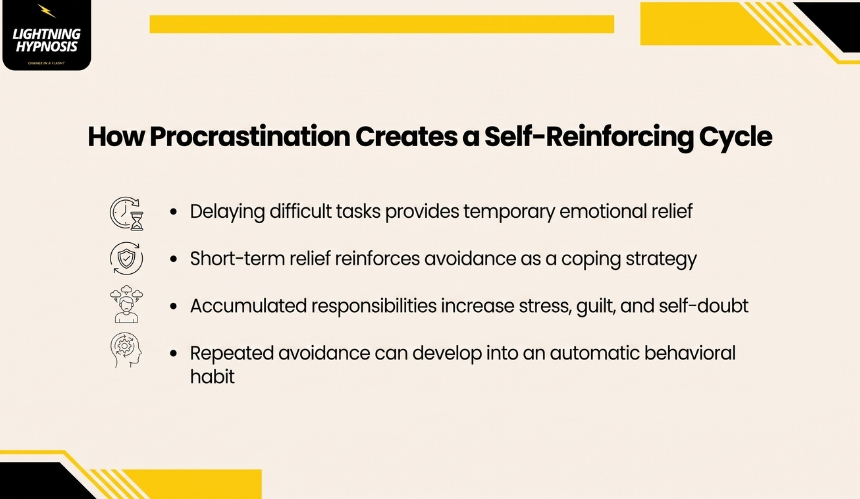
Procrastination is not simply a repeated choice to delay work. Over time, it can become a learned behavioral pattern in which short-term emotional relief reinforces future avoidance. This cycle explains why procrastination often persists even after someone recognizes its negative consequences and genuinely wants to change.
Delaying a Task Feel Better in the Moment
When a task triggers anxiety, uncertainty, frustration, or mental effort, postponing it often produces an immediate sense of relief. In behavioral psychology, this process is known as negative reinforcement. The behavior of delaying is strengthened because it temporarily removes an unpleasant emotional state.
Although the relief is short-lived, the brain registers it as a successful coping strategy. Each time avoidance reduces discomfort, the likelihood of repeating the same response increases. Over time, the brain begins to associate challenging tasks with escape rather than engagement.
Stress, Guilt, and Reduced Confidence Fuel the Cycle
The emotional relief gained from procrastination rarely lasts. As deadlines approach or responsibilities accumulate, stress levels increase and feelings of guilt, shame, and self-criticism often emerge. These emotions make the original task feel even more emotionally demanding than it was at the beginning.
Repeated experiences of unfinished work can also weaken self-confidence. Individuals may begin to question their reliability, discipline, or competence, despite having the necessary skills. This reduced confidence increases hesitation the next time a similar task appears, making future procrastination more likely.
Repeated Delays Become Automatic Habits
The brain becomes more efficient at behaviors that are repeated consistently. When procrastination follows a familiar sequence of discomfort, avoidance, temporary relief, and increased pressure, that sequence can develop into an automatic habit loop.
Over time, relatively small cues such as opening a work document, receiving an email, or thinking about an important project may trigger avoidance with little conscious awareness. Breaking this cycle requires changing the response to those cues rather than relying solely on greater willpower or motivation.
Research on habit formation shows that replacing an established routine with a more adaptive behavior is generally more effective than attempting to suppress the habit altogether.
When Procrastination May Signal a Deeper Issue
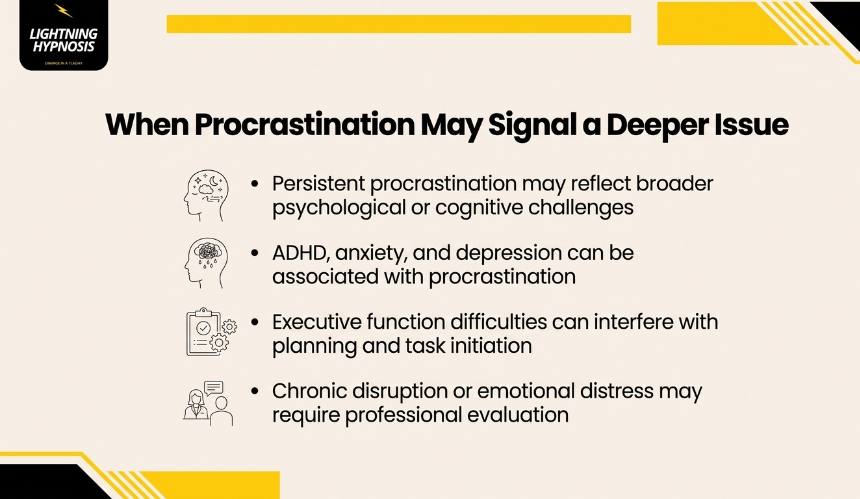
Occasional procrastination is a common human behavior and does not necessarily indicate an underlying condition. However, when procrastination becomes persistent, significantly disrupts work, education, relationships, or daily functioning, it may reflect broader psychological or neurocognitive challenges that warrant closer attention.
How Are ADHD, Anxiety, and Depression Connected to Procrastination?
Several mental health conditions are associated with higher rates of procrastination, although they do not cause procrastination in every individual.
For people with attention-deficit/hyperactivity disorder (ADHD), procrastination is often linked to difficulties with executive functioning, including planning, prioritizing, sustaining attention, and initiating tasks. Delaying work may result from these cognitive challenges rather than a lack of motivation.
In anxiety disorders, procrastination frequently develops as an avoidance strategy. Delaying a task temporarily reduces worry about performance, uncertainty, or potential failure, even though it often increases anxiety over time.
With depression, reduced energy, diminished interest, impaired concentration, and slowed cognitive processing can make even routine responsibilities feel disproportionately difficult to begin or complete. In these cases, procrastination may be a symptom of the broader condition rather than an isolated habit.
What Are Executive Function Challenges and Emotional Regulation Difficulties?
Executive functions are higher-order cognitive processes that enable people to organize information, manage attention, regulate impulses, switch between tasks, and pursue long-term goals. When these processes are impaired, individuals may know exactly what needs to be done but struggle to translate intention into action.
Emotional regulation also remains central. Difficulty tolerating frustration, uncertainty, or perceived imperfection can interfere with task initiation even when the required knowledge or skills are present. This interaction between executive functioning and emotional regulation helps explain why procrastination often persists despite strong personal motivation.
When Should Someone Consider Seeking Professional Support?
Professional support may be appropriate when procrastination becomes chronic, causes repeated academic or occupational difficulties, affects relationships, or is accompanied by symptoms such as persistent anxiety, low mood, severe inattention, or emotional distress.
A qualified psychologist, psychiatrist, or other licensed mental health professional can evaluate whether procrastination is part of a broader clinical picture and recommend evidence-based interventions when necessary.
Seeking help should not be viewed as an admission of poor discipline. Instead, it is a practical step toward identifying underlying factors and developing strategies that address the root cause rather than only the visible behavior.
Evidence-Based Strategies That Actually Reduce Procrastination
Because procrastination is often maintained by emotional, cognitive, and behavioral processes, effective solutions should target those mechanisms rather than relying on willpower alone. Research suggests that sustainable improvement comes from reducing the psychological barriers to action, making tasks easier to initiate, and creating systems that encourage consistent follow-through.
Reduce Emotional Resistance Before Trying to Increase Productivity
Attempting to force productivity while ignoring emotional resistance often leads to repeated avoidance. Instead, identify the specific feeling attached to the task, whether it is uncertainty, fear of making mistakes, boredom, or feeling overwhelmed. Naming the emotion can reduce its intensity and make the task feel more manageable.
One practical approach is to focus only on starting rather than finishing. Committing to a small amount of work, such as reading one page or writing a single paragraph, lowers the emotional threshold for action and increases the likelihood of continuing once momentum develops.
Break Tasks Into Smaller, Immediately Actionable Steps
Large, undefined goals increase cognitive load because the brain must first determine where to begin. Converting a complex objective into specific, concrete actions reduces ambiguity and simplifies task initiation.
For example, replacing “finish the report” with steps such as gathering references, outlining key points, and drafting the introduction creates a clear sequence of achievable actions. Completing these smaller milestones also provides frequent progress cues that reinforce continued effort.
Design Your Environment to Reduce Friction and Distractions
The surrounding environment influences behavior more than motivation alone. Removing unnecessary distractions decreases the number of competing stimuli that can interrupt focused work.
Simple environmental adjustments may include silencing nonessential notifications, keeping only relevant materials visible, scheduling dedicated focus periods, or using website blockers during deep work sessions. Making productive behaviors easier and distracting behaviors less accessible reduces the mental effort required to stay on task.
Build Consistent Habits Instead of Waiting for Motivation
Motivation naturally fluctuates because it is influenced by emotions, energy levels, and external circumstances. Habits, by contrast, rely on repetition and stable cues rather than momentary willingness to act.
Establishing a consistent work routine, beginning important tasks at the same time each day, or linking a new behavior to an existing habit can gradually automate productive actions.
Over time, consistency reduces dependence on motivation and strengthens behavioral patterns that support long-term goal achievement. While setbacks are inevitable, returning to the routine quickly is more effective than waiting until motivation feels high again.
Can Procrastination Hypnotherapy Help?
Some people explore procrastination hypnotherapy as a complementary approach, particularly when procrastination is driven by anxiety, fear of failure, or deeply ingrained thought patterns. While early research suggests hypnotherapy may help some individuals change unhelpful beliefs and improve emotional regulation, the current evidence remains more limited than for established treatments such as cognitive behavioral therapy (CBT).
For best results, hypnotherapy should be viewed as one component of a broader, evidence-based strategy rather than a standalone solution.
Frequently Asked Questions
Why do I only become productive when a deadline is close?
Deadline pressure can narrow attention, reduce competing choices, and make the cost of inaction feel immediate. That urgency may trigger action, but it does not prove that work quality improves under pressure. Experimental research found that self-imposed deadlines can reduce delay, although people often set them less effectively than externally structured deadlines.
Can procrastination affect my sleep even when I finish my work on time?
Procrastination can disrupt sleep through bedtime procrastination, which involves delaying sleep without an unavoidable external reason. Late-night scrolling, unfinished personal activities, or attempts to reclaim free time can shorten sleep duration. Poor sleep may then weaken next-day attention and self-control, increasing vulnerability to further procrastination.
Does smartphone use cause procrastination, or does it just make it more visible?
Problematic smartphone use and procrastination appear to reinforce each other rather than follow one simple cause-and-effect pathway. Notifications, endless feeds, and immediate digital rewards create frequent opportunities to disengage from demanding tasks. However, people already experiencing self-regulation difficulties may also reach for their phones more often, so device removal addresses only part of the pattern.
Is “active procrastination” actually a healthy way to work?
Active procrastination describes deliberately delaying work while retaining control, meeting deadlines, and performing effectively. Some studies associate it with productive coping under pressure. However, researchers debate whether intentional, consequence-free delay should be called procrastination at all, since modern definitions usually involve unnecessary postponement despite expected harm.
Why do I postpone small tasks that would take only a few minutes?
Small tasks can be delayed when they feel irritating, low-value, or too minor to demand immediate attention. They may also contain hidden decisions, such as choosing a time, locating information, or switching activities. Assigning a specific behavioral cue, such as completing the task immediately after lunch, removes those repeated micro-decisions.